

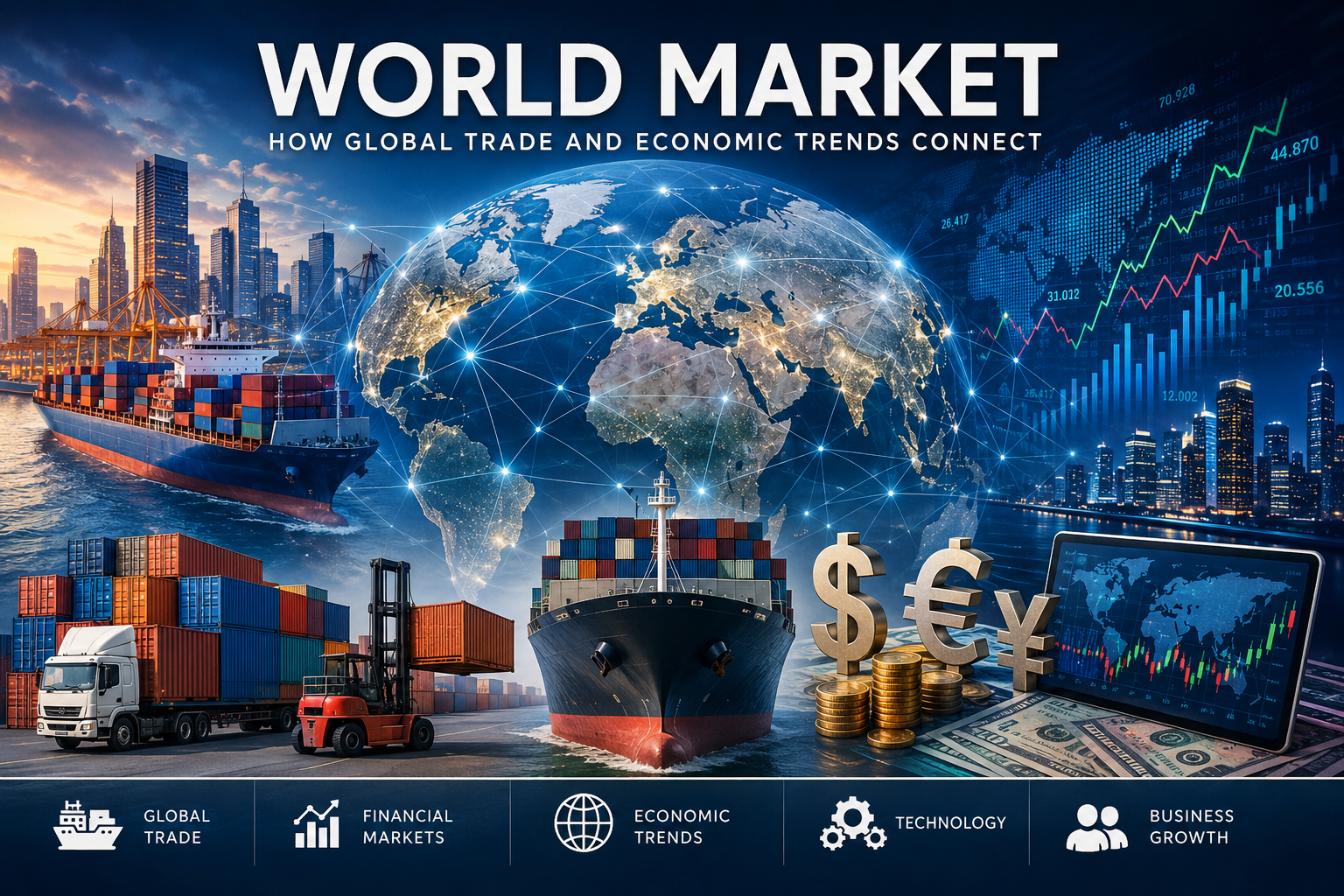
The world market refers to the interconnected system through which countries, companies, investors, consumers, and financial institutions exchange goods, services, capital, and resources. It is not a single marketplace or exchange. Instead, it is a broad network linking national economies through international trade, investment, currencies, commodities, technology, and financial markets.
Understanding the world market helps explain why an energy-price shock in one region can affect transportation costs elsewhere, why changes in interest rates influence currencies and investments, and why demand for technology can reshape manufacturing supply chains across continents.
What Is the World Market?
At its simplest, the world market is the global network of economic activity between countries. It includes physical products such as oil, food, vehicles, machinery, and electronics, as well as services such as banking, software, tourism, transportation, and professional consulting.
Financial markets are another major component. Stocks, bonds, currencies, commodities, and other financial instruments move across borders as investors respond to economic conditions, interest rates, corporate performance, and geopolitical developments.
International trade is particularly important. According to the World Trade Organization, global trade in goods and commercial services increased 8% in 2025 to approximately $34.89 trillion, with services accounting for 27.5% of global trade.
This interconnected structure means that national economies rarely operate in isolation.
How the World Market Works
The system operates through several closely connected channels.
Trade: Countries export products and services in which they have competitive advantages and import goods that are more expensive or difficult to produce domestically.
Finance: Banks, investment funds, corporations, and individuals move capital across borders. These flows can finance businesses, infrastructure, acquisitions, and government borrowing.
Currencies: International transactions require currency exchange. Changes in exchange rates can affect import costs, export competitiveness, inflation, and investment returns.
Commodities: Oil, natural gas, metals, agricultural products, and other raw materials influence production costs worldwide.
Technology: Digital services and technology supply chains increasingly connect businesses without requiring physical products to cross borders.
| Market Area | What It Includes | Why It Matters |
|---|---|---|
| Goods trade | Electronics, food, machinery, vehicles | Connects manufacturers and consumers |
| Services trade | Software, finance, tourism, transport | Supports increasingly digital economies |
| Financial markets | Stocks, bonds, currencies | Directs capital around the world |
| Commodity markets | Energy, metals, agriculture | Influences production and inflation |
| Technology | AI, semiconductors, digital services | Reshapes productivity and supply chains |
These areas influence one another. For example, higher energy costs can raise manufacturing and shipping expenses, which may eventually affect consumer prices and corporate profits.
Major Forces Shaping the Global Economy
The world market is constantly changing, but several forces are especially significant in 2026.
Trade Policy and Tariffs
Government trade policies can alter where companies source materials, manufacture products, and sell goods. Tariffs may increase the cost of imported products, while trade agreements can reduce barriers between participating economies.
Businesses increasingly have to consider not only production costs but also tariff exposure, shipping routes, supplier concentration, and political risk.
Artificial Intelligence and Technology
Artificial intelligence has become an important source of global investment and demand. The WTO reported that strong trade in AI-enabling products contributed to stronger-than-expected trade growth in 2025.
The impact extends beyond software. AI development requires data centers, advanced chips, networking equipment, electricity, cooling systems, and specialized infrastructure. That creates demand across multiple industries and countries.
Energy Prices
Energy remains one of the most important links between geopolitics and economic performance. Higher oil and gas prices can increase transportation, manufacturing, electricity, and food costs.
The WTO warned in 2026 that prolonged high energy prices could reduce merchandise trade growth from its baseline forecast of 1.9% to around 1.4%.
For businesses, this makes energy exposure an important consideration when evaluating international suppliers and markets.
Geopolitical Risk
Wars, sanctions, diplomatic disputes, shipping disruptions, and political instability can quickly change trade routes and investment decisions.
The World Bank’s June 2026 outlook projected global growth to slow to 2.5% in 2026, citing the effects of the Middle East conflict, higher energy prices, and renewed economic pressures.
The exact impact varies by country. Energy importers, exporters, manufacturers, and commodity-producing economies can experience very different outcomes from the same event.
What the World Market Means for Businesses
Companies operating internationally need to look beyond local demand. Currency movements can change revenue and costs, while supply-chain disruptions can affect inventory and delivery schedules.
A business importing components, for example, may face higher costs if its domestic currency weakens against the supplier’s currency. A company selling products overseas may benefit from favorable exchange rates but could face weaker demand if the target economy slows.
Businesses can reduce exposure by diversifying suppliers, monitoring international regulations, maintaining flexible inventory strategies, and evaluating alternative markets.
💡 Pro Tip: Don’t judge an overseas market by population or GDP alone. Compare currency stability, import rules, logistics infrastructure, consumer purchasing power, energy exposure, and political conditions before committing resources.
How Investors Can Read Global Market Signals
Investors often monitor several indicators to understand international conditions.
Interest rates are important because they influence borrowing costs, currencies, bonds, and equity valuations. Inflation affects consumer purchasing power and central-bank policy. Employment data can provide clues about economic demand, while manufacturing and trade figures offer insight into business activity.
Commodity prices can also provide an early warning about changing conditions. Rising energy prices may signal supply pressure, while falling industrial-metal demand can sometimes indicate weaker manufacturing activity.
There is no single indicator that explains the entire global economy. Investors generally need to consider several signals together.
Risks and Opportunities
The world market creates opportunities for companies and investors, but international integration also creates vulnerabilities.
Businesses can reach new customers, access specialized suppliers, attract foreign investment, and take advantage of international expertise. Digital services make it possible for some companies to sell internationally without establishing physical operations in every country.
At the same time, international exposure can increase sensitivity to tariffs, currency movements, geopolitical events, shipping disruptions, inflation, and changes in consumer demand.
The WTO’s 2026 trade outlook expects merchandise trade growth to moderate after stronger growth in 2025, while services trade is projected to continue expanding faster than goods trade.
That distinction matters because services, particularly digitally delivered services, can respond differently to economic disruptions than physical goods.
📌 Key Takeaway: The world market is best understood as a connected economic system rather than a single marketplace. Trade, currencies, commodities, technology, investment, and geopolitics continually influence one another, so understanding these connections is more useful than watching one headline or economic indicator.
Frequently Asked Questions
What does the world market mean?
The world market describes international economic activity involving trade, investment, finance, currencies, commodities, and services. It connects businesses, governments, consumers, and investors across national borders and allows economic developments in one country to influence activity elsewhere.
Why is the world market important?
It gives businesses access to international customers, suppliers, capital, technology, and resources. For consumers, international trade can increase product variety and connect local economies to global supply chains. It also allows countries to specialize in industries where they are relatively competitive.
What affects world market the most?
Interest rates, inflation, economic growth, energy prices, trade policy, geopolitical events, currency movements, technological investment, and consumer demand are among the major influences. Their effects vary depending on the country, industry, and economic conditions.
How does global trade affect consumers?
International trade can influence product availability, prices, and purchasing choices. Changes in shipping costs, tariffs, exchange rates, energy prices, or supply-chain conditions can eventually affect the prices consumers pay for imported and domestically produced goods.
Is the global economy expected to grow in 2026?
Major institutions expect continued global economic activity, although forecasts differ. The World Bank’s June 2026 outlook projected global growth of 2.5% in 2026, while the IMF’s April 2026 outlook projected 3.1%. Differences reflect different assumptions, models, and publication dates.
Conclusion
The world market connects economies through far more than imports and exports. Financial flows, currencies, energy, technology, services, and supply chains all contribute to an increasingly interconnected economic system.
For businesses and investors, the practical lesson is to watch several factors at once. Trade policy, technology investment, energy costs, interest rates, and geopolitical developments can move together and produce very different results across industries. Staying informed about these relationships makes it easier to understand international opportunities and prepare for changing economic conditions.
