

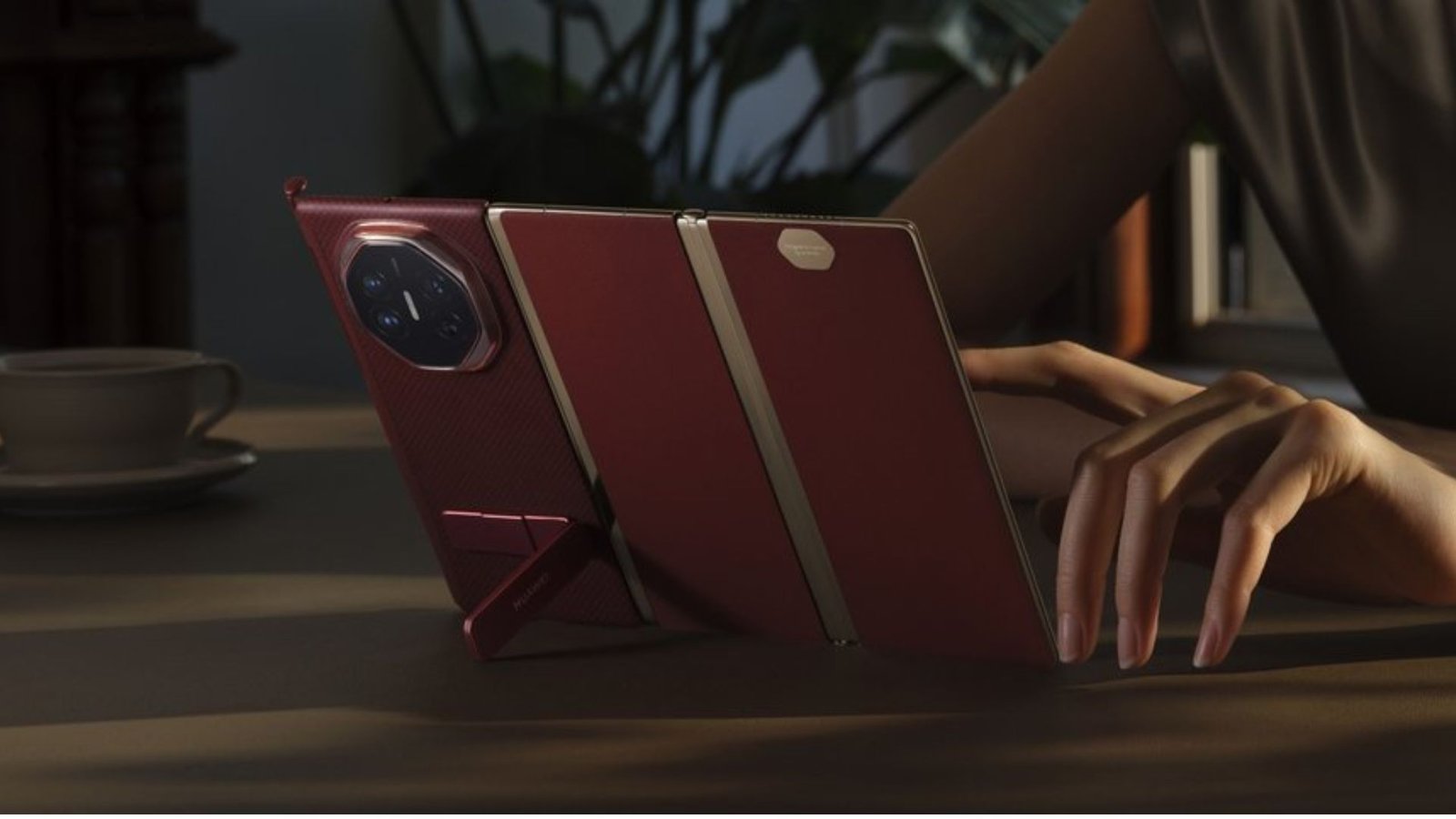
The Huawei Mate XT is one of the most distinctive foldable smartphones ever released. Instead of folding once like conventional book-style devices, it uses two hinges to transform from a regular phone into a larger dual-screen device and finally into a 10.2-inch tablet-sized display. Huawei positions it as a combination of smartphone portability and large-screen productivity.
For buyers researching the Huawei Mate XT, the biggest questions are not simply about screen size. Its unusual design raises practical considerations around weight, durability, software, cameras, battery life, pricing, and availability. Understanding those details helps explain where this tri-fold phone fits in the growing foldable market.
What Makes the Huawei Mate XT Different?
The defining feature is its dual-hinge, tri-fold design. The phone can be used in three configurations: a 6.4-inch single-screen mode, a 7.9-inch partially opened mode, and a fully unfolded 10.2-inch display. Huawei lists the fully opened screen at 3K resolution, with a 2,232 × 3,184-pixel resolution.
That flexibility gives the device a different purpose depending on how it is opened. The compact configuration works like a conventional smartphone, the middle configuration provides additional screen space for multitasking, while the fully unfolded mode is better suited to documents, media, browsing and other tablet-style tasks.
Huawei’s official product information also highlights a precision hinge system designed to coordinate the inward and outward folding movements. The hinge core uses high-strength steel, while the display incorporates a composite structure designed to improve resistance to bending and impact.
Huawei Mate XT Specifications at a Glance
| Specification | Huawei Mate XT |
|---|---|
| Foldable design | Dual-hinge tri-fold |
| Display sizes | 6.4″, 7.9″, 10.2″ |
| Display type | OLED, up to 90Hz adaptive refresh |
| Full display resolution | 2232 × 3184 pixels |
| Processor | Kirin 9010 |
| RAM | 16GB |
| Storage | Up to 1TB |
| Main camera | 50MP Ultra Aperture |
| Ultra-wide camera | 12MP |
| Telephoto camera | 12MP periscope |
| Battery | 5,600mAh typical |
| Wired charging | Up to 66W |
| Weight | Approximately 298g |
Huawei’s specifications confirm the 16GB RAM and 1TB storage configuration, along with the 5,600mAh typical battery capacity and 66W wired charging support.
Display and Design
The display is the main reason to consider this phone. In its largest configuration, the 10.2-inch OLED panel provides a much larger workspace than standard smartphones while remaining part of a device that can fold down to a phone-sized form.
The screen supports up to a 90Hz adaptive refresh rate, 1,440Hz high-frequency PWM dimming and up to 240Hz touch sampling. Huawei lists 382 pixels per inch for the display system.
The physical design is equally unusual. Huawei lists the folded thickness at 12.8mm, while the fully unfolded sections measure as little as 3.6mm and 4.75mm depending on the section. The device weighs approximately 298g before accounting for the screen protector.
That means portability comes with a trade-off: this is considerably heavier than many conventional smartphones. The advantage is the ability to carry a tablet-like screen without carrying a separate tablet.
💡 Pro Tip:
If you are considering a tri-fold phone, think about how often you would genuinely use the larger display. The Huawei Mate XT makes the most sense for people who regularly read documents, manage multiple apps, view large spreadsheets or consume media on a bigger screen.
Performance and Multitasking
The Huawei Mate XT uses Huawei’s Kirin 9010 octa-core platform and pairs it with 16GB of RAM. Storage is available up to 1TB, giving users substantial room for applications, photographs, videos and documents.
The larger display also changes how multitasking works. Huawei demonstrates single-screen, dual-screen and triple-screen modes designed for different tasks. With more display area available, users can work with multiple application windows rather than constantly switching between full-screen apps.
For productivity, this is arguably more meaningful than simply having a larger screen. A tri-fold format can provide room for reading material alongside notes, browsing information while working on a document, or viewing content without repeatedly changing screens.
Software support remains an important consideration, particularly for buyers outside Huawei’s strongest markets. The international model uses EMUI 14.2 according to Huawei’s regional specifications, so prospective buyers should verify app compatibility and regional software support before purchasing.
Camera System
The camera setup is designed to make the phone more than a display-focused experiment. It includes a 50MP Ultra Aperture main camera with optical image stabilisation, a 12MP ultra-wide camera and a 12MP periscope telephoto camera with optical image stabilisation. Huawei lists approximately 5.5x optical zoom and up to 50x digital zoom.
The main camera’s variable aperture ranges from f/1.4 to f/4.0, giving the system flexibility across different lighting conditions. The telephoto camera also provides greater reach for distant subjects without relying entirely on digital magnification.
For buyers, the key point is that the Mate XT is not simply a folding tablet with basic smartphone cameras. Its imaging hardware is closer to what users expect from a premium flagship device.
Battery Life and Charging
The phone has a 5,600mAh typical battery, with Huawei listing a rated capacity of 5,500mAh. It supports up to 66W wired SuperCharge when paired with the appropriate Huawei charging equipment.
A large flexible display can demand considerable power, particularly when the phone is used fully unfolded. The substantial battery therefore matters because users may switch between the compact phone configuration and the much larger tablet-style screen throughout the day.
Huawei also highlights its thin silicon-anode battery construction as part of the device’s design.
Price and Availability
The original Chinese launch price started at CNY 19,999 for the 256GB model, with higher prices for the 512GB and 1TB versions. The international launch in 2025 carried a €3,499 recommended price in markets where the global model was introduced.
Availability has been more limited than that of mainstream flagship smartphones. Huawei launched the international model in selected markets, including Malaysia, Indonesia, the Philippines, the UAE, Saudi Arabia and Mexico, rather than broadly distributing it across the US and UK at the initial global launch.
Buyers should therefore check the official Huawei store for their specific country instead of assuming that an international model has the same warranty, software support or network compatibility everywhere.
Is the Huawei Mate XT Practical?
The Huawei Mate XT is best understood as a specialist premium foldable rather than an ordinary smartphone replacement.
Its strongest argument is versatility. One device can function as a conventional phone, a larger multitasking screen and a tablet-sized display. The 10.2-inch panel is particularly useful for productivity and media consumption.
The compromises are equally clear. The device is heavy, expensive and mechanically more complicated than a traditional smartphone. Foldable displays also require more care than conventional glass smartphone screens. Availability and software compatibility can further affect the experience depending on the country.
📌 Key Takeaway:
The Huawei Mate XT stands out because its two hinges create three usable screen configurations in one device. Its 10.2-inch OLED display, 16GB RAM, 1TB storage option, 5,600mAh battery and versatile camera system make it a serious piece of mobile hardware, but its premium price and regional availability mean buyers should evaluate the practical benefits carefully.
Frequently Asked Questions
Is the Huawei Mate XT a tri-fold phone?
Yes. It uses two hinges and can be configured as a 6.4-inch phone, a 7.9-inch partially unfolded device or a 10.2-inch fully unfolded screen. This three-stage design distinguishes it from conventional single-hinge foldable phones.
How big is the Huawei Mate XT when fully unfolded?
The fully unfolded display measures 10.2 inches diagonally and uses a 2,232 × 3,184-pixel resolution. Huawei describes it as a 3K display designed for large-screen viewing and productivity.
How much RAM and storage does it have?
The international specifications list 16GB of RAM and 1TB of internal storage. Huawei also states that external memory expansion is not supported, so choosing the appropriate storage capacity at purchase is important.
Does the Huawei Mate XT support fast charging?
Yes. The phone supports up to 66W Huawei SuperCharge through compatible charging equipment. Huawei lists a 5,600mAh typical battery capacity, although its rated capacity is 5,500mAh.
Is the Huawei Mate XT available everywhere?
No. The international launch was limited to selected markets, and availability can differ by country. Anyone considering an imported unit should verify local network compatibility, warranty coverage, software features and official support before purchasing.
Final Thoughts
The Huawei Mate XT represents a different direction for foldable smartphones. Rather than making a phone slightly larger, Huawei created a device that moves between phone, dual-screen and tablet-sized formats. The 10.2-inch OLED display, high-end camera hardware, large battery and generous memory make the concept technically compelling.
For readers researching the Huawei Mate XT, the most useful question is not simply whether its specifications are impressive. It is whether the tri-fold design solves a real need. For users who value a large mobile workspace and want one device to replace both a phone and occasional tablet, its unusual format has clear appeal. For everyone else, the price, weight and regional limitations deserve equal attention.

1 Comment
Pingback: Samsung S25: Features, Specs, Camera, Battery and More - QuantumRun