

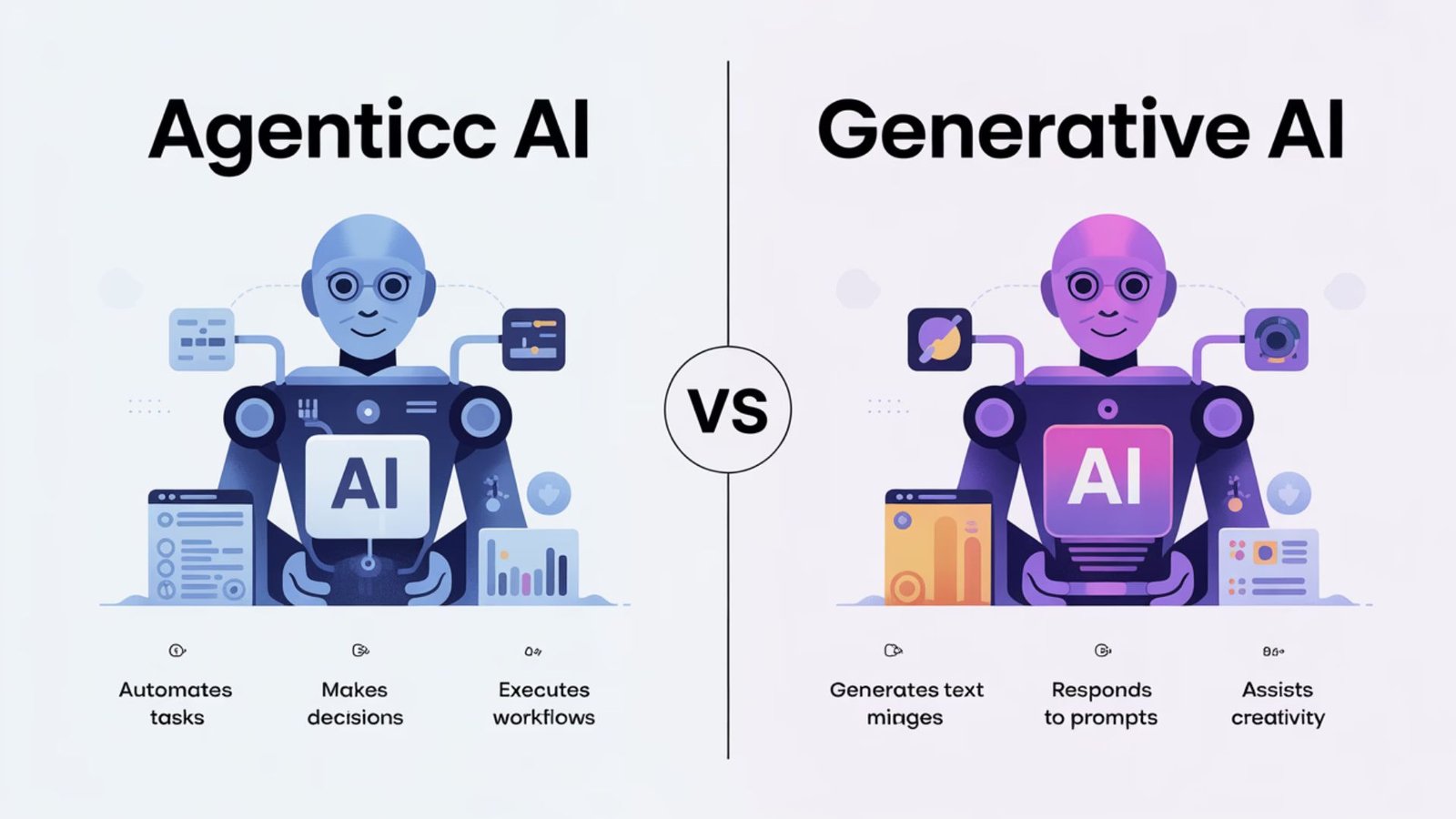
Artificial intelligence has moved beyond simply generating answers. The difference between agentic AI vs generative AI is mainly about what an AI system does after receiving an instruction. Generative AI is primarily designed to create content such as text, images, audio, video, summaries, and code. Agentic AI extends AI capabilities toward goals, planning, tool use, decision-making, and multi-step task execution.
That distinction matters for businesses, developers, and everyday users deciding which type of AI technology fits a particular workflow. A content writer may need a system that produces a draft, while a business may need an AI system that can gather information, update records, coordinate several steps, and work toward a defined objective.
What Is Generative AI?
Generative AI refers to AI models designed to generate new synthetic content from learned patterns and the information supplied as context. NIST describes generative AI as a class of models capable of producing derived content including text, images, video, audio, and other digital material.
A typical generative AI application responds to a prompt. For example, a user could ask an AI assistant to:
- Write a product description.
- Summarize a long report.
- Create software code.
- Generate an image from a description.
- Rewrite an email.
- Explain a technical concept.
The model can produce useful results quickly, but the user generally remains responsible for reviewing the output and deciding what happens next. Generative AI can also be connected to external information or tools, so the distinction is not simply that generative systems can never take actions. The central purpose is content generation and transformation.
What Is Agentic AI?
Agentic AI is designed around achieving a goal rather than simply producing a single response. Depending on its architecture and permissions, an agent can interpret an objective, break it into tasks, use tools, evaluate information, and continue through multiple steps. NIST describes agentic AI in terms of goal-directed behavior, decision-making, adaptation, and interaction with users and systems.
For example, imagine a company wants to investigate a customer-service issue. A generative AI application could summarize the customer’s messages and draft a response. An agentic system could potentially retrieve the relevant account information, examine the support history, determine which workflow applies, update an approved system, and prepare or send a response according to defined permissions.
Agentic systems can have different levels of autonomy. Some require approval before important actions, while others can complete narrowly defined tasks with limited human intervention. AWS notes that agentic architectures can combine an LLM with retrieval, tools, and memory to perceive information, reason about a goal, and act within an environment.
Agentic AI vs Generative AI: Core Differences
The easiest way to understand agentic AI vs generative AI is to compare their primary objectives and operating models.
| Feature | Generative AI | Agentic AI |
|---|---|---|
| Primary purpose | Generate or transform content | Achieve a defined goal |
| Typical input | Prompt, question, or supplied context | Goal, objective, event, or instruction |
| Main output | Text, images, code, audio, summaries, or other content | Decisions, actions, completed steps, and sometimes generated content |
| Workflow | Usually prompt-response oriented | Often multi-step and iterative |
| Tool use | May use tools when integrated | Tool use is commonly central to task execution |
| Autonomy | Usually more user-directed | Can operate with greater autonomy within permissions |
| Human role | Reviews or guides outputs | May supervise, approve, or intervene at defined points |
| Typical example | Drafting a report | Researching information, coordinating tasks, and updating systems |
The important distinction is not that one technology is simply “smarter” than the other. Their purposes can overlap, and modern applications frequently combine them. IBM similarly describes generative AI as focused on creating content while agentic AI adds planning, decision-making, external-system interaction, and goal-oriented execution.
How Agentic AI Uses Generative AI
Agentic AI does not necessarily replace generative AI. In many architectures, generative models provide an important reasoning and language capability inside a larger agentic workflow.
Consider an online retailer that wants to automate parts of inventory management. A generative model could analyze supplier messages and produce a summary. An agentic workflow could use that information to check inventory, compare approved supplier data, determine whether a reorder condition has been met, and initiate an authorized action.
This relationship is one reason the agentic AI vs generative AI comparison can be misleading when treated as a strict either-or choice. An agent may rely on a large language model to understand instructions and generate content while other components provide memory, retrieval, APIs, permissions, and orchestration. AWS documentation describes LLMs as a cognitive component that can support planning, tool use, and adaptive behavior in agentic systems.
💡 Pro Tip:
Start by mapping the workflow before choosing the technology. If the task ends when useful content is produced, a generative application may be sufficient. If the system must continue gathering information, making decisions, calling tools, and completing several approved actions, consider an agentic architecture.
When Should You Use Generative AI?
Generative AI is generally well suited to tasks where the desired result is information or newly created content. Common applications include marketing drafts, customer-service responses, coding assistance, document summarization, translation, brainstorming, and content transformation.
It can also support employees who need to work with large amounts of unstructured information. Instead of manually reviewing every document, users can ask a model to summarize material, extract relevant information, or reorganize it into a more useful format.
For these applications, human review can remain an important control, particularly when accuracy, compliance, privacy, or business consequences matter.
When Should You Use Agentic AI?
Agentic AI becomes more relevant when a workflow requires multiple connected steps rather than a single generated response. Examples include:
- Coordinating tasks across business applications.
- Managing certain customer-service workflows.
- Monitoring events and responding according to predefined policies.
- Conducting multi-step research.
- Supporting software-development workflows.
- Gathering information before making an authorized decision.
- Orchestrating multiple specialized AI agents.
The complexity of the task should determine the level of agency. AWS recommends increasing agency when the task complexity requires it rather than adding autonomy without a clear reason.
Organizations also need to consider permissions, security, monitoring, testing, auditability, and human oversight. Greater autonomy can increase the potential impact of both successful and unsuccessful actions.
Can Businesses Use Both?
Yes. In many practical systems, the two approaches work together.
A customer-service platform could use generative AI to understand a customer’s request and draft natural-language communication. An agentic layer could determine which systems need to be checked, retrieve relevant information, update permitted records, and coordinate the next steps.
Software development provides another example. A generative model can assist with code generation and explanation, while an agentic workflow can organize implementation tasks, run tools such as tests, inspect results, and iterate according to predefined conditions.
This combined approach means businesses do not necessarily need to choose one technology for every AI project. The appropriate architecture depends on the task, available data, required integrations, acceptable autonomy, and governance requirements.
📌 Key Takeaway
The central difference in agentic AI vs generative AI is the job the system is designed to perform. Generative AI focuses mainly on producing or transforming content, while agentic systems are built to pursue goals through planning, tool use, decisions, and actions. In many real-world applications, the strongest architecture may combine both.
Frequently Asked Questions
Is agentic AI the same as generative AI?
No. Generative AI primarily creates or transforms content, while agentic AI is oriented toward achieving goals through actions and multi-step workflows. Agentic systems can use generative models as part of their architecture, so the technologies are related but not identical.
Is ChatGPT generative AI or agentic AI?
ChatGPT is widely associated with generative AI because it can generate text and other content. However, AI products can also incorporate tool use and agentic capabilities. The classification therefore depends on the specific features, workflow, and level of autonomous action provided by a particular implementation.
Which is more autonomous?
Agentic systems are generally designed to operate with greater autonomy than a basic generative AI application. An agent can plan multiple steps and interact with tools or systems within its permissions. The actual autonomy varies by implementation, safeguards, and the amount of human approval required.
Can generative AI become part of an AI agent?
Yes. A generative model can serve as the language and reasoning component within an AI agent. The broader system can add tools, retrieval, memory, orchestration, permissions, and evaluation mechanisms that allow it to pursue a goal and take actions.
What should a business consider before adopting agentic AI?
Businesses should evaluate the workflow, required integrations, data access, security controls, permissions, monitoring, human oversight, and consequences of incorrect actions. Starting with a narrowly defined use case and clear boundaries can make testing and governance more manageable.
Conclusion
Understanding agentic AI vs generative AI becomes easier when the distinction is framed around outcomes. Generative AI is particularly useful for creating, transforming, and interpreting content. Agentic AI extends those capabilities into goal-oriented workflows where systems can plan, use tools, evaluate results, and take authorized actions.
For organizations, the practical question is not simply which technology is newer. It is what the workflow actually requires. A content-generation task may need only a generative model, while a complex process involving multiple systems and decisions may benefit from an agentic design. In many cases, combining both provides a more flexible approach while keeping human oversight and appropriate controls in place.
