

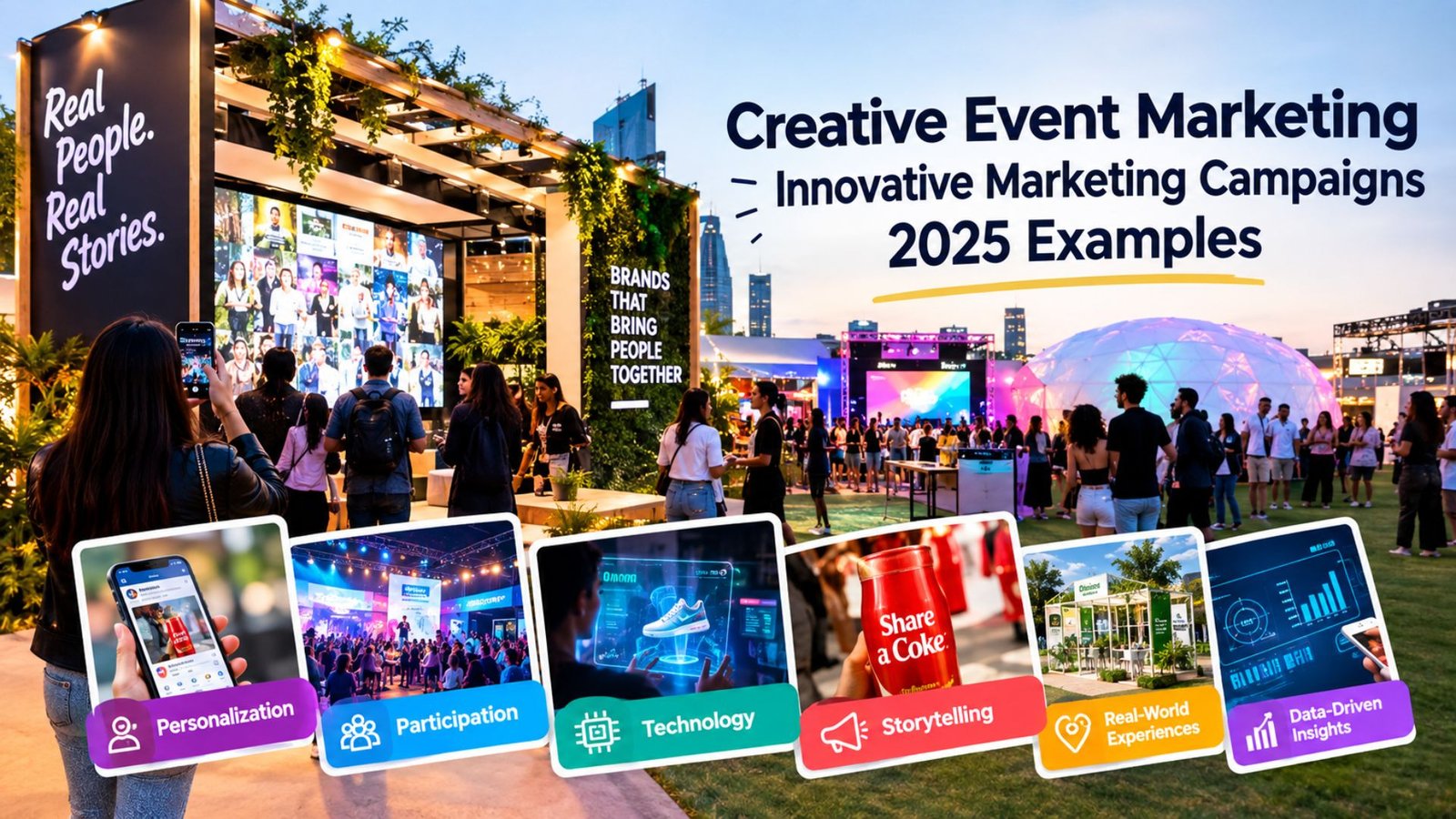
Innovative marketing campaigns 2025 examples show how brands moved beyond conventional advertising by combining personalization, participation, technology, cultural relevance, and real-world experiences. From Coca-Cola’s return of Share a Coke to Google’s 50-state storytelling and Vaseline’s community-driven verification, strong ideas made audiences part of the experience.
For marketers studying innovative marketing campaigns 2025 examples, the useful question is not which brand spent the most, but which creative mechanism made the audience care and participate.
Innovative marketing campaigns 2025 examples worth studying
Coca-Cola: Share a Coke returns
Coca-Cola brought Share a Coke back in 2025, updating the long-running idea for a new generation. Personalized packaging was combined with digital and real-world experiences, giving consumers a reason to look for names, share products, and create content.
Google Workspace: 50 States, 50 Stories
Google Workspace used the 2025 Super Bowl moment to spotlight 50 small businesses, with one story from every U.S. state. Rather than focusing only on product features, Google showed how real businesses were using AI and Workspace tools.
This is one of the strongest innovative marketing campaigns 2025 examples for B2B and technology marketers because the product was demonstrated through human stories. A company can explain a complex feature more clearly by showing the problem it solves.
Vaseline Verified: community content with expert validation
Vaseline Verified built its creative around skincare hacks circulating online. The campaign tested community-submitted ideas and used a verification concept to separate useful tips from myths.
The important idea is the role reversal: the audience supplied the raw material while the brand added expertise and testing. Similar models can work for software workflows, recipes, product tips, or customer questions.
💡 Pro Tip:
If you use user-generated content, establish an editorial filter first. Decide what qualifies, how claims will be checked, and what should be rejected. Participation works better when audiences trust the process.
Dove: The Code and marketing in the AI era
Dove’s 2025 work around “The Code” connected its Real Beauty platform with concerns about AI and digitally altered beauty imagery. Instead of treating AI as a novelty, the campaign used a technology issue to reinforce an established brand position.
AXA Three Words: changing the service itself
AXA France’s Three Words campaign focused on domestic-violence support by adding assistance and emergency relocation provisions to home insurance contracts. The campaign received multiple Cannes Lions recognitions in 2025.
Spotify Wrapped: turning data into participation
Spotify Wrapped continued its personalized campaign in 2025, turning individual listening data into stories users could explore and share. Spotify also expanded the experience into physical activations and introduced Wrapped Party.
Among innovative marketing campaigns 2025 examples, Wrapped is particularly relevant to brands that collect customer data. Data becomes more engaging when it tells customers something meaningful about themselves rather than presenting a conventional dashboard.
What these campaigns have in common
| Campaign | Core idea | Marketing lesson |
|---|---|---|
| Share a Coke | Personalization | Make customers part of the creative |
| 50 States, 50 Stories | Local storytelling | Demonstrate products through real use |
| Vaseline Verified | Community content | Turn participation into useful content |
| The Code | AI and brand purpose | Connect technology to a brand promise |
| AXA Three Words | Service innovation | Let the product support the campaign |
| Spotify Wrapped | Data storytelling | Give customers something worth sharing |
Across these innovative marketing campaigns 2025 examples, several patterns stand out. Studying innovative marketing campaigns 2025 examples can help teams identify mechanisms worth adapting rather than copying.
Participation: Customers can provide stories, data, ideas, photos, reviews, or creative responses instead of remaining passive viewers.
Purposeful technology: AI, personalization, and data work best when they improve the experience rather than become the entire idea.
Real-world activation: Digital campaigns can become more memorable when people encounter them through packaging, events, retail spaces, or local communities.
Brand consistency: The strongest concepts connect to something recognizable. Coca-Cola used sharing, Spotify used listening data, Vaseline used community hacks, and Google used real business stories.
How to build a campaign inspired by these examples
Start with an audience problem rather than an advertising format. Identify something customers already care about, discuss, create, or struggle with.
Then find the brand asset that can help: customer data, a product feature, community, expertise, packaging, local presence, or service.
Next, create a participation mechanism. Customers might personalize an item, submit content, compare results, vote, or share a story.
Finally, connect measurement to the campaign objective. Track outcomes such as qualified traffic, trials, conversions, retention, or customer-generated content. High visibility alone does not prove business success.
Mistakes marketers should avoid
A campaign does not become innovative because it uses AI, influencers, augmented reality, or a large budget. Technology without a useful customer experience can add complexity without adding value.
Do not copy another campaign’s surface features. Study the underlying mechanism and adapt it to your audience, category, and resources.
Also avoid participation without a reason. If customers are asked to submit content or complete a challenge, give them a clear benefit, entertaining experience, useful result, or meaningful connection.
📌 Key Takeaway
The most practical innovative marketing campaigns 2025 examples show that originality often comes from combining familiar strengths in a new way. Personalization, customer participation, real stories, useful data, technology, and service improvements become powerful when they solve a genuine audience need.
Frequently Asked Questions
What makes a marketing campaign innovative?
Innovation can come from the idea, customer experience, distribution, technology, product, or business model. A campaign becomes more meaningful when the new approach improves how people interact with the brand instead of simply adding a fashionable format.
Are these ideas suitable for small businesses?
Yes. Small businesses can use the same principles through personalized emails, customer stories, useful user-generated content, local experiences, and simple data-driven campaigns without copying the scale of major brands.
How can AI improve a marketing campaign?
AI can support research, personalization, content production, testing, segmentation, and automation. Its best use depends on the objective. Marketers should still verify claims, protect customer information, and maintain human oversight.
Should a campaign focus on virality?
Virality can increase reach, but it should not be the only objective. A campaign should support a clear business goal such as awareness, qualified leads, sales, retention, or product adoption.
What should marketers learn from 2025 campaigns?
The central lesson is relevance. Strong concepts give audiences a reason to participate while connecting that participation to a genuine brand strength or customer need.
Conclusion
The most useful innovative marketing campaigns 2025 examples are worth studying because their creative ideas connect audience behavior with a real business strength or customer need. Instead of copying a trend, marketers can ask what would give their own audience a reason to participate, remember, and share.
