

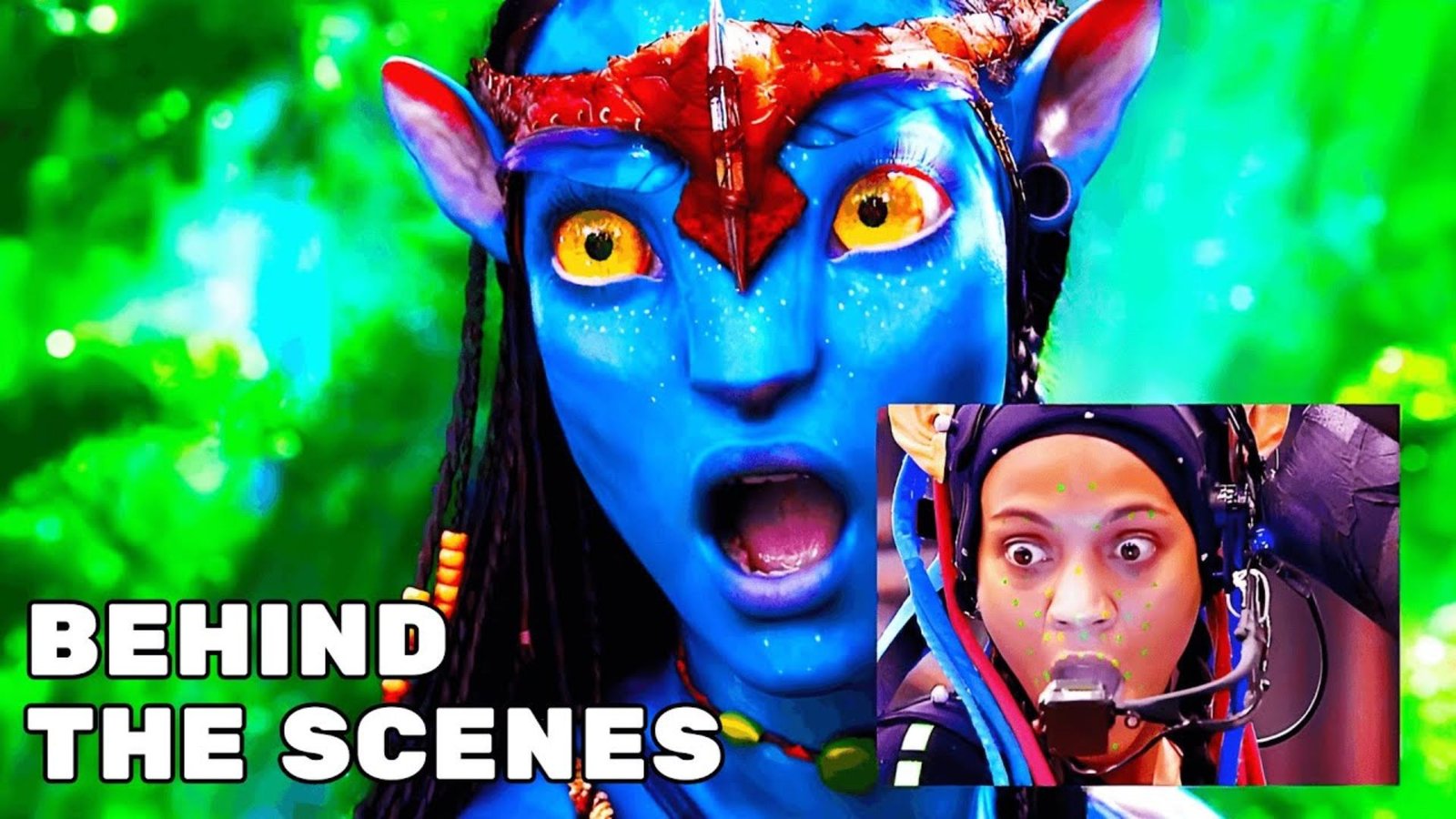
The finished Avatar films make Pandora feel like a place that existed before a camera ever arrived. The reality is far more complicated. Avatar behind the scenes production combines actors performing on specialized capture stages, physical sets, underwater training, virtual filmmaking, conventional live-action photography, and years of visual-effects work.
James Cameron’s approach is particularly unusual because computer-generated imagery does not simply replace the actors. Their physical movements, facial expressions, timing, and emotional performances become the foundation from which the Na’vi characters are created. The technology is sophisticated, but the filmmaking still begins with people performing scenes together.
How Avatar Behind the Scenes Filming Actually Works
A common misconception is that the cast simply records dialogue while visual-effects artists create everything else. Performance capture is much closer to acting on a highly instrumented stage.
Actors wear suits fitted with tracking markers that record body movement. Facial performance is captured separately through small head-mounted camera systems. That information gives filmmakers detailed performance data that can later be transferred to digital characters.
For Avatar: The Way of Water, Cameron’s team pushed the process further by developing methods for performance capture in water. Disney’s production account explains that Cameron wanted actors genuinely swimming, diving, surfacing, and reacting to currents rather than imitating those actions on a dry stage.
That distinction matters. A digital character may be created inside a computer, but its movement can originate from an actor struggling against real water, turning naturally while swimming, or reacting physically to another performer.
From Performance Capture to a Virtual Pandora
One of the most fascinating parts of Avatar behind the scenes footage is how different the raw filming environment looks from the final movie.
A capture stage may contain relatively little scenery. Actors can be surrounded by tracking equipment rather than forests, cliffs, alien animals, or enormous Na’vi villages. Cameron nevertheless needs to understand how a scene will eventually appear inside Pandora.
The solution is the virtual camera.
After performances have been captured, Cameron can effectively photograph the digital scene from different positions inside the computer-generated environment. According to Disney, the system allowed him to see the characters in their intended locations rather than simply viewing the actors on the capture stage.
This separates two filmmaking decisions that are usually made at the same time: the actor’s performance and the final camera position. A strong performance can be captured first, while composition and virtual cinematography can continue afterward.
| Production Stage | What Is Captured or Created | Why It Matters |
|---|---|---|
| Performance capture | Actors’ movement and physical interaction | Provides the foundation for digital characters |
| Facial capture | Expressions and facial motion | Preserves emotional detail |
| Underwater capture | Swimming and movement in real water | Produces believable aquatic motion |
| Virtual camera work | Digital framing and camera movement | Lets Cameron photograph Pandora virtually |
| Live-action filming | Human characters, props and selected environments | Connects physical photography with digital scenes |
| Visual effects | Characters, creatures, environments and simulations | Builds the finished cinematic image |
Why Underwater Filming Became Such a Challenge
The Avatar behind the scenes story became considerably more complicated with Avatar: The Way of Water.
The production constructed a large water tank at Manhattan Beach Studios for underwater performance capture. Disney reported dimensions of approximately 120 feet long, 60 feet wide, and 30 feet deep, with capacity exceeding 250,000 gallons. The production could also generate currents and wave interaction.
Ordinary scuba equipment created another problem: bubbles could interfere with the optical tracking system by confusing cameras attempting to identify performance-capture markers.
Actors and some crew members therefore trained in breath-hold diving. The cast studied freediving techniques with instructor Kirk Krack, allowing scenes to be performed underwater without clouds of bubbles disrupting the capture process.
💡 Pro Tip
When watching Avatar behind the scenes material, compare an actor’s body position and facial reaction with the finished Na’vi performance. The environments may change completely, but subtle movements, eye direction, timing, and physical interaction often reveal how closely the final character remains connected to the original performance.
The Visual Effects Work Does Not Start From Nothing
Once filming and virtual cinematography establish a scene, enormous amounts of digital work remain.
Wētā FX has played a central role in transforming performance data into the finished characters and environments. Visual-effects supervisor Joe Letteri explained that performances are studied frame by frame so the digital result preserves what the actors were doing emotionally.
This is an important distinction in understanding Avatar behind the scenes production. Visual effects are not merely about making blue characters look realistic. Artists must preserve recognizable acting choices while also handling skin, eyes, hair, muscles, clothing, water, vegetation, lighting, creatures, and interaction between digital and photographed elements.
Avatar: The Way of Water eventually won the Academy Award for Visual Effects, while 20th Century Studios described the film as establishing a new visual-effects benchmark.
Practical Sets Still Have a Major Role
Pandora may be digitally expanded, but Avatar filmmaking is not entirely virtual.
The official Avatar site has published behind-the-scenes galleries showing physical laboratory environments, production vessels, actors filming underwater, capture stages, and practical production spaces.
The later production of Avatar: Fire and Ash continued combining physical construction with digital filmmaking. Avatar’s official site has highlighted production designers Ben Procter and Dylan Cole discussing hundreds of practically constructed sets used while expanding Pandora.
Practical elements give performers objects, surfaces, spatial references, and other actors with which to interact. Digital extensions can then transform those foundations into environments impossible to construct at full scale.
READ ALSO :One Piece Live Action Season 2 Cast: Full Guide
The Behind-the-Scenes Story Has Become Part of the Franchise
Interest in Avatar behind the scenes production has grown enough to become entertainment in its own right.
In November 2025, the official Avatar site announced Fire And Water: Making The Avatar Films, a two-part Disney+ documentary covering the production of Avatar: The Way of Water and offering material from Avatar: Fire and Ash. It includes concept art, filmmaking footage, interviews, underwater production work, and the development of performance-capture techniques.
The documentary also shows how widely the filmmaking process extends beyond visual-effects facilities, following production activity across locations including California, Hawaii, the Bahamas, and New Zealand.
📌 Key Takeaway
The defining feature of Avatar’s production is not CGI alone. Its distinctive look comes from layering genuine performances, specialized capture technology, physical production, virtual cinematography, and detailed visual-effects craftsmanship until the boundaries between them become difficult to see.
Frequently Asked Questions
How are the Na’vi actors filmed in Avatar?
Actors perform scenes using performance-capture equipment that records body movement and facial information. Those performances become the basis for digital Na’vi characters. Visual-effects teams then refine anatomy, skin, clothing, lighting, hair, and environmental interaction while working to preserve the emotional details of the original acting.
Did the Avatar cast really film underwater?
Yes. For Avatar: The Way of Water, cast members performed substantial material in an actual water tank rather than relying entirely on simulated underwater movement. Actors received freediving training so they could hold their breath during performance capture without scuba bubbles interfering with the tracking technology.
What is the virtual camera used in Avatar?
The virtual camera allows James Cameron to view and frame digitally constructed scenes as though he were operating a camera inside Pandora. It gives the director considerable freedom to select shots after performance data has been recorded, while maintaining the actors’ original movements and interactions.
Is everything in Avatar computer-generated?
No. Avatar combines digital environments and characters with practical sets, physical props, live-action photography, water tanks, production vehicles, and real actor performances. Official production galleries show laboratory sets, underwater filming, capture stages, and other physical elements used alongside digital filmmaking.
Where can viewers watch official Avatar behind-the-scenes footage?
The official Avatar website publishes production images and videos, while Disney+ carries Fire And Water: Making The Avatar Films. The two-part documentary focuses on Avatar: The Way of Water and Avatar: Fire and Ash, with interviews, concept work, production footage, and material explaining underwater performance capture.
Why the Process Matters
Avatar behind the scenes filmmaking reveals why describing the franchise as simply “CGI-heavy” misses most of the process. Cameron’s films depend on technology, but that technology is built around performances, camera choices, physical movement, production design, and painstaking artistic interpretation.
From actors holding their breath underwater to filmmakers exploring Pandora through a virtual camera, the illusion works because several forms of filmmaking operate together. Understanding those layers makes the finished world of Pandora even more remarkable: what appears effortless on screen is the product of performance, engineering, design, photography, and visual effects working as one production system.
Conclusion
Avatar behind the scenes reveals that the world of Pandora is built through much more than computer-generated imagery. Performance capture, facial tracking, practical sets, underwater acting, virtual cameras, and detailed visual effects all contribute to what audiences finally see on screen.
James Cameron’s production methods are designed to keep human performance at the center of the technology. Actors still provide the movement, expressions, timing, and emotional foundation, while digital artists transform those performances into Na’vi characters and extraordinary environments.

1 Comment
Pingback: Saw 11: Latest Updates, Cast, Story and Release Status - QuantumRun