

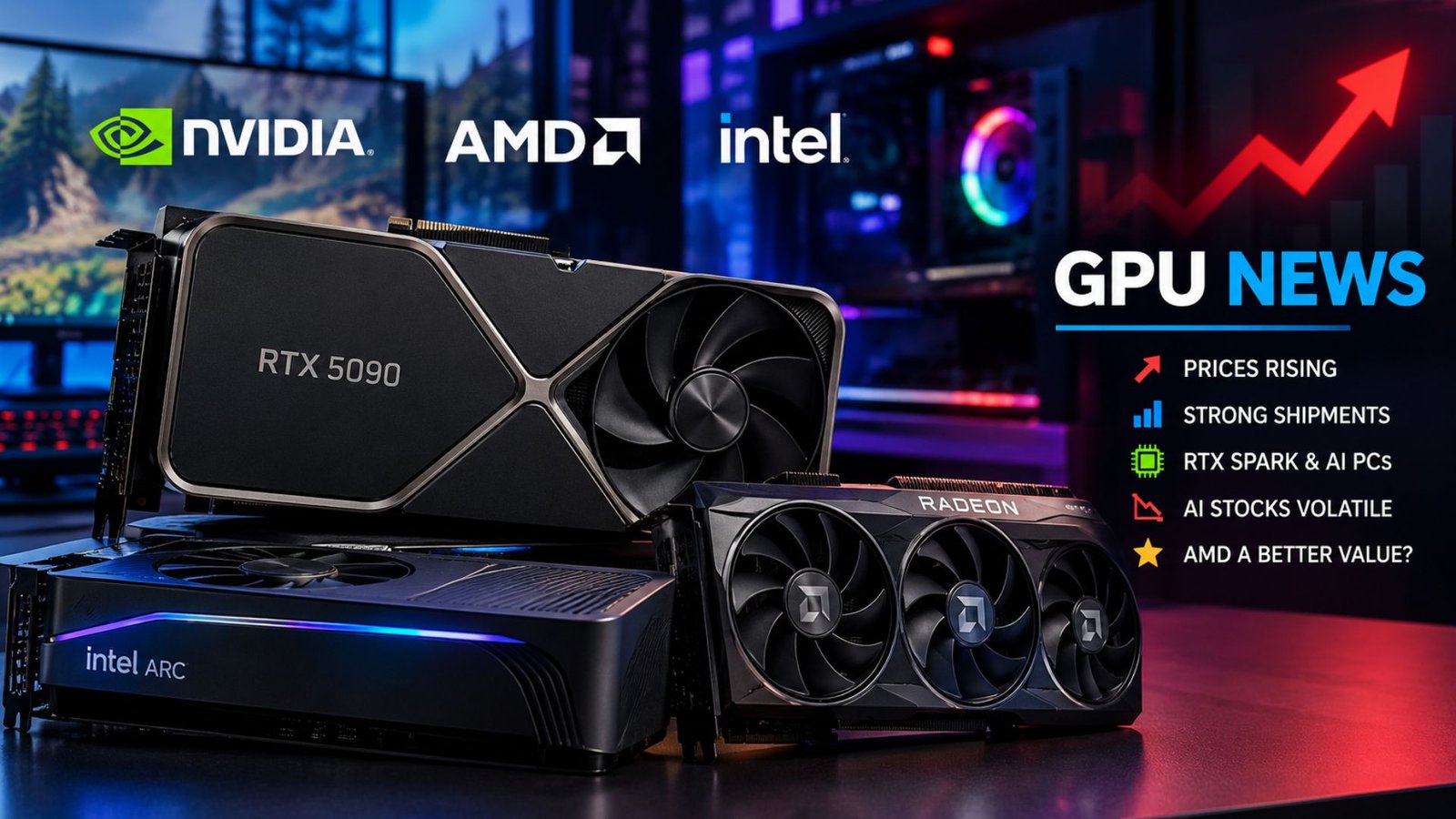
GPU technology is moving quickly, with gaming performance, artificial intelligence, pricing, memory availability, and software becoming increasingly connected. The latest gpu news shows that graphics cards are no longer competing only on frame rates. Nvidia, AMD, and Intel are also pushing harder into AI workloads, neural rendering, professional computing, and efficient local processing. For buyers, that makes understanding current developments more useful than simply comparing model numbers.
What the Latest GPU News Means for Buyers
The graphics card market in 2026 is being shaped by two competing forces: strong demand and increasingly expensive high-end hardware. Recent industry data reported by Tom’s Hardware indicates that desktop add-in-board shipments reached 12.5 million units in the second quarter of 2026, the highest quarterly level since early 2022. Nvidia accounted for about 90% of those desktop shipments, while AMD and Intel held much smaller shares.
At the same time, prices remain a major concern. Current gpu news coverage shows that buyers can find substantial differences between recommended pricing, retailer pricing, and prices from third-party sellers. The situation is especially noticeable at the premium end, where limited availability can push flagship cards far above their intended retail prices.
This means shoppers should evaluate an entire graphics card platform rather than assuming the newest model is automatically the best purchase.
Nvidia Continues to Push AI and Neural Rendering
Nvidia remains the dominant name in consumer discrete graphics, but its strategy is increasingly influenced by artificial intelligence. Its RTX 50-series hardware supports advanced neural rendering technologies, while DLSS continues to expand beyond traditional image upscaling.
Nvidia officially launched DLSS 5 in September 2026, initially bringing its neural-rendering technology to NBA 2K27 on GeForce RTX 50-series hardware and GeForce NOW. The company has also highlighted additional games receiving DLSS-related technologies.
That development matters because modern GPU performance is no longer measured only by native rendering speed. AI-assisted frame generation, reconstruction, lighting, and image quality can substantially change how games look and perform.
Recent gpu news also highlights an unusual market shift involving the RTX 5090. Reports indicate that first-party online inventory has become difficult to find in the United States, while some third-party listings have reached dramatically higher prices.
Why AI Matters to Gaming GPUs
AI features can extend the practical life of graphics hardware by allowing games to generate additional frames or reconstruct images more efficiently. However, buyers should distinguish generated frames from traditional rendered frames. A higher displayed frame rate does not necessarily mean the GPU is producing the same number of fully rendered frames.
For competitive gaming, latency and native performance still matter. For visually demanding single-player games, advanced reconstruction and frame-generation technologies can be much more attractive.
AMD Is Closing Gaps in More Than Gaming
AMD’s Radeon division remains an important alternative for buyers looking beyond Nvidia. The current generation includes Radeon RX 9000-series products, while the company’s broader GPU strategy also extends into workstation and AI computing.
Recent market reporting suggests AMD has gained ground in parts of the discrete GPU market, particularly as notebook graphics demand has increased.
One of the more interesting developments in gpu news is the continuing effort to make AMD hardware more compatible with software ecosystems traditionally associated with Nvidia. A recent project demonstrated CUDA-related workloads running on an AMD Radeon RX 9060 XT under Windows through a software compatibility approach. This does not mean AMD GPUs natively support CUDA in the same way Nvidia hardware does, but it illustrates how software compatibility is becoming an increasingly important battleground.
💡 Pro Tip:
If you are buying a GPU for AI development, check software compatibility before comparing benchmark scores. Framework support, libraries, drivers, and memory capacity can matter more than a small difference in gaming performance.
Intel Still Matters in the GPU Market
Intel’s Arc graphics products continue to provide another option in the consumer GPU market. Although Nvidia holds a much larger share of desktop add-in-board shipments, Intel remains relevant because competition can influence pricing, features, and product availability.
For consumers, a three-company market is generally healthier than one in which a single manufacturer faces little pressure. Intel’s continued participation also gives budget-conscious PC builders another ecosystem to consider, particularly when evaluating value rather than absolute flagship performance.
The latest gpu news therefore should not be viewed only through the lens of Nvidia versus AMD. Intel’s progress, driver development, and future architectures can affect the wider market even when its current market share remains comparatively small.
What Is Happening With GPU Prices?
GPU pricing is one of the most important issues for anyone planning a PC upgrade. Current tracking across Nvidia, AMD, and Intel shows that prices vary significantly by generation, model, retailer, and availability.
| GPU Market Area | What Buyers Should Watch | Why It Matters |
|---|---|---|
| Nvidia RTX 50 Series | Availability and premium pricing | High-end demand can push street prices upward |
| AMD Radeon RX 9000 Series | Performance and value | Strong alternative for gaming-focused builds |
| Intel Arc | Driver support and pricing | Competitive option in selected segments |
| Older GPUs | Used-market condition | Can offer value but require careful inspection |
| AI-focused hardware | VRAM and software ecosystem | Workloads may prioritize memory and compatibility |
A sensible purchase should therefore consider total value rather than launch specifications alone. A previous-generation card at a substantial discount may be a better choice than a newer model with a much higher street price.
The Growing Importance of VRAM
Video memory has become a major topic in gpu news, particularly as modern games use higher-resolution textures, ray tracing, large open-world environments, and increasingly sophisticated rendering techniques.
VRAM also matters for AI workloads. Local image generation, language models, video processing, and other computational tasks can consume large amounts of memory. That does not mean every buyer needs a massive VRAM capacity, but it does mean memory should be evaluated according to the intended workload.
For a gaming PC, resolution and game settings should guide the decision. Someone targeting 1080p esports gaming has very different requirements from a creator working with high-resolution video or a developer experimenting with local AI models.
Power, Cooling, and Connectors Deserve Attention
Performance is only one part of modern graphics card design. Power consumption, cooling, case clearance, and connector quality can all influence the ownership experience.
Recent reports have highlighted power-connector concerns involving both high-end Nvidia and AMD graphics cards. A modified RTX 5090 test, for example, demonstrated extremely high power draw, while a separate report described a melted 8-pin connector on a Radeon RX 7900 XTX system. These reports should not be interpreted as proof that every card or connector will fail, but they reinforce the importance of proper installation and adequate power delivery.
What GPU Buyers Should Watch Next
The most useful gpu news is likely to involve the intersection of hardware and software. Future graphics cards will increasingly be judged by AI acceleration, neural rendering, driver features, memory capacity, power efficiency, and support for emerging applications.
For gamers, that means checking real-world performance at the resolution they actually use. For creators and AI developers, software support and VRAM may deserve greater weight. For budget buyers, price-to-performance remains the strongest metric.
📌 Key Takeaway:
The best graphics card is not necessarily the newest or most expensive model. Compare real-world performance, VRAM, software support, power requirements, availability, and street price before buying.
Frequently Asked Questions
What is the most important GPU trend right now?
AI-assisted rendering is one of the biggest developments. Technologies such as frame generation and neural rendering are changing how GPUs deliver visual performance, while AI workloads are also increasing demand for high-memory graphics hardware.
Should I buy a new GPU or wait?
The answer depends on pricing and your current hardware. If your existing GPU comfortably handles your games or applications, waiting for a meaningful price reduction or a product that offers a clear performance improvement can make sense.
Is Nvidia still the leading GPU company?
Nvidia remains the dominant supplier of desktop discrete graphics cards according to recent shipment data. However, AMD and Intel continue competing through different combinations of performance, pricing, features, and software support.
Does more VRAM always mean a faster GPU?
No. VRAM capacity and GPU processing performance are different characteristics. More memory can help with demanding textures, high resolutions, and certain AI workloads, but it does not automatically make a graphics card faster in every application.
Where can I follow reliable GPU updates?
Following manufacturer announcements from Nvidia, AMD, and Intel alongside established hardware publications is a practical approach. Comparing multiple sources helps separate confirmed product information from rumors, leaks, and speculative reports.
The broader gpu news landscape shows a market moving beyond traditional graphics performance. Nvidia’s AI-focused strategy, AMD’s competition in gaming and computing, Intel’s continued presence, changing GPU prices, and rapid software development are all influencing purchasing decisions. For most buyers, the smartest approach is to focus on the workload first and the brand second. A well-priced GPU with the right memory, software support, and performance can remain a better investment than an expensive flagship that exceeds your actual needs.
Conclusion
The latest gpu news shows that the graphics card market is evolving far beyond traditional gaming performance. AI acceleration, neural rendering, VRAM capacity, power efficiency, software support, and pricing are becoming equally important factors. Nvidia continues to lead the market, while AMD and Intel provide meaningful competition across different segments. For buyers, the smartest choice is to match a GPU to actual gaming, creative, or AI requirements rather than simply choosing the newest or most expensive model.

1 Comment
Pingback: IoT Technology: How Connected Devices Work- QuantumRun