

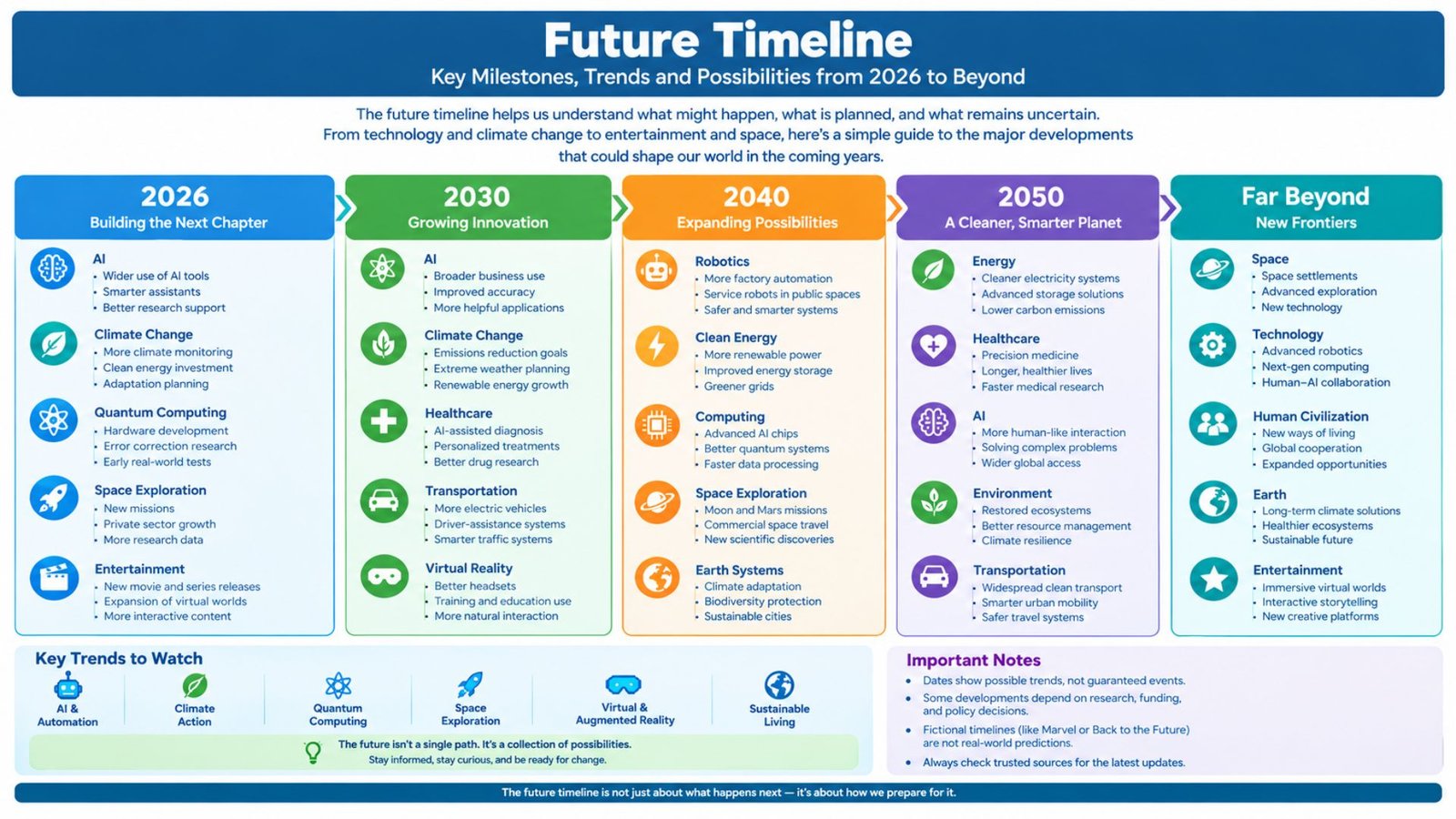
future timeline helps organize these possibilities by separating what is happening now, what may happen over the next few years, and what remains uncertain. This guide explores the 2026 future timeline, artificial intelligence, climate change, quantum computing, entertainment franchises, and long-term predictions in simple language. It also includes a detailed comparison table, practical examples, and answers to common questions so readers can understand the evidence, identify uncertainty, and make better-informed decisions.
What Is a Future Timeline?
A future timeline is a structured overview of events, developments, goals, or predictions arranged by date or period. It can describe scientific research, technology adoption, environmental changes, business trends, or events expected within a fictional story.
For example, a technology company might publish a timeline for releasing a new product. Climate researchers may project possible environmental changes through 2050, while a film franchise might use a fictional timeline to explain the order of its stories.
A useful timeline separates three categories:
- Confirmed milestones: Events that have already happened or dates officially announced by a reliable organization.
- Evidence-based projections: Possible future outcomes supported by research, models, or current trends.
- Speculative predictions: Ideas about what might happen without enough evidence to establish a dependable date or outcome.
Understanding these differences makes future planning more realistic and prevents guesses from being mistaken for facts.
What Does the 2026 Future Timeline Look Like?
The 2026 future timeline is best understood through major developments already underway rather than a list of guaranteed predictions. Artificial intelligence, energy systems, medical research, space exploration, and digital entertainment are all areas worth watching.
The following table summarizes important areas and their possible direction. It is a planning guide, not a schedule of guaranteed breakthroughs.
Detailed Future Timeline: 2026 to 2050 and Beyond
| Period | Area | Expected or possible development | Confidence |
|---|---|---|---|
| 2026 | Artificial intelligence | Wider use of AI assistants, automated workflows, and AI-supported research | Ongoing trend |
| 2026 | Climate change | Continued climate monitoring, clean-energy investment, and adaptation planning | Ongoing trend |
| 2026 | Quantum computing | Research into error correction, hardware, and practical applications | Ongoing research |
| 2026–2030 | Healthcare | Greater use of AI-assisted analysis and personalized treatment tools | Depends on evidence and approval |
| 2026–2030 | Transportation | Further development of electric vehicles and driver-assistance technology | Ongoing trend |
| 2026–2030 | Virtual reality | Improvements in immersive entertainment, training, and collaboration | Plausible trend |
| 2030 | Climate policy | Progress toward national and international emissions targets | Depends on policy and implementation |
| 2030–2040 | Robotics | Potential expansion of robots in manufacturing, logistics, and selected services | Plausible, uneven adoption |
| 2030–2040 | Space exploration | Possible new scientific missions and expanded commercial activity | Mission-dependent |
| 2040–2050 | Energy | Potentially cleaner electricity systems and improved energy storage | Depends on technology and investment |
| 2040–2050 | Computing | Possible advances in AI hardware and specialized computing systems | Uncertain pace |
| 2050 and beyond | Earth systems | Long-term climate and ecosystem outcomes shaped by emissions and adaptation | Scenario-dependent |
| Far future | Human civilization | Speculation about advanced robotics, space settlements, and new computing capabilities | Highly uncertain |
This table is intentionally cautious. A target year does not prove that a technology will become commercially available by that date, and a government target does not guarantee that its intended outcome will be achieved.
How Will Artificial Intelligence Shape the Future Timeline?
Artificial intelligence is already used for writing assistance, software development, image analysis, customer support, data processing, and scientific research. Future development may focus on making these systems more useful, reliable, secure, and capable of completing multistep tasks.
AI future timeline: 2026 to 2030
During this period, organizations may expand AI use in areas such as:
- Automating repetitive office tasks.
- Supporting software testing and development.
- Improving access to educational resources.
- Helping researchers analyze large datasets.
- Assisting customer service and business operations.
However, the pace of adoption will depend on cost, regulation, data quality, security, and whether these systems produce reliable results.
AI will also create challenges. Workers may need new skills, businesses will need safeguards against inaccurate outputs, and governments will continue addressing privacy, accountability, and safety.
What is the most important AI milestone to watch? Rather than focusing on a single predicted breakthrough, watch for measurable improvements in accuracy, affordability, security, and real-world usefulness.
What Is the Quantum Computing Future Timeline?
Quantum computing uses quantum-mechanical principles to process information in ways that differ from conventional computing. Researchers are working on quantum hardware, error correction, control systems, and methods for solving particular computational problems.
Quantum computers are not expected to replace ordinary computers for everyday tasks across the board. Their potential value lies in specialized problems that may benefit from quantum methods.
Possible quantum computing milestones
- 2026–2030: Continued hardware development, improved error-correction methods, and testing of practical applications.
- 2030–2040: Potential progress toward more capable systems, depending on engineering and research breakthroughs.
- 2040 and beyond: Wider commercial impact is possible, but its timing and scale remain uncertain.
Potential applications include certain chemistry simulations, materials research, and specialized optimization problems. Researchers must still demonstrate clear advantages over the best available classical methods for specific tasks.
How Could Climate Change Affect the Future Timeline?
Climate change is a long-term process rather than an event that begins in one particular year. Its future effects depend heavily on greenhouse gas emissions, natural variability, adaptation measures, and the speed of the transition to lower-emission energy systems.
A climate change future timeline should consider several connected issues:
- Temperature: Global warming increases the likelihood and severity of many heat extremes.
- Extreme weather: Climate change affects the risks associated with heat, heavy rainfall, drought, and other hazards, although local outcomes vary.
- Sea levels: Rising sea levels increase risks for coastal communities over time.
- Food and water: Changing temperatures and rainfall patterns can put pressure on agriculture and water supplies.
- Energy: Electricity networks, storage, and low-emission technologies will influence future energy systems.
The year 2030 is important because many climate commitments use it as a milestone for reducing emissions. However, countries’ pledges, actual policies, and achieved emissions reductions are different things.
The future Earth timeline is therefore not fixed. Faster emissions reductions and effective adaptation can limit some risks, while continued high emissions increase long-term challenges.
What Does the Marvel Future Timeline Look Like?
The Marvel future timeline is a fictional chronology, not a scientific prediction. Marvel stories include multiple universes, alternate realities, time travel, and events that can change the order in which characters experience history.
The Marvel Cinematic Universe (MCU) also distinguishes between a film’s release date and the period when its story takes place. These two timelines should not be confused.
MCU future timeline explained
To understand the MCU, readers should separate:
- Release order: The sequence in which Marvel films and television series became available.
- Story chronology: The order of events within the fictional universe.
- Multiverse chronology: Alternate realities that may contain different versions of characters and events.
Marvel’s official release announcements can help identify confirmed upcoming projects, but an announced release date does not establish every detail of a future story.
A Marvel movie future timeline should therefore be checked against official announcements and the story information actually released. Avoid treating fan theories about future films as confirmed plot details.
What Is the Back to the Future Timeline?
The Back to the Future franchise explores how changes to past events can affect the future. Marty McFly and Doc Brown travel between different periods, creating consequences that alter family histories and the world around them.
The main films follow Marty and Doc through a series of interconnected adventures:
- Back to the Future (1985) introduces the original time-travel story.
- Back to the Future Part II (1989) explores multiple periods and altered versions of events.
- Back to the Future Part III (1990) moves the adventure into the American Old West.
A back to the future timeline can become confusing because characters do not always experience events in the same order as viewers see them. The most useful approach is to distinguish the characters’ personal experiences from the changing history they create.
These stories are fictional explorations of causality. They do not demonstrate that real-world time travel into the past is possible.
What Is the Stranger Things Future Timeline?
Stranger Things combines supernatural events, government experiments, friendships, and mysteries in the fictional town of Hawkins, Indiana. Its timeline follows the characters as they encounter increasingly serious threats connected to the Upside Down.
To understand the Stranger Things future timeline, it helps to distinguish between the events shown in released episodes and speculation about later developments.
A reliable viewing guide should identify:
- The year in which each season’s principal events take place.
- The sequence of events affecting the main characters.
- Connections between the Upside Down and Hawkins.
- Officially confirmed information about later installments.
Predictions about character endings, unresolved mysteries, and future spin-offs should be labeled as theories until the creators or official releases confirm them.
What Is the Past, Present, and Future Timeline?
The past, present, and future timeline is a simple way to organize events according to when they happen. It is useful for education, personal planning, history, project management, and understanding how decisions affect later outcomes.
Past
Events that have already happened, such as historical discoveries, previous decisions, and completed projects.
Present
Current circumstances, available information, ongoing activities, and decisions being made now.
Future
Planned events, goals, possible outcomes, and developments that have not happened yet.
For kids, this concept can be explained with a school example: yesterday’s homework belongs to the past, today’s lesson belongs to the present, and tomorrow’s test belongs to the future.
A past present future timeline for kids can use pictures, short labels, and dates to make the idea easier to understand.
What Is the One Piece Future Timeline?
One Piece follows Monkey D. Luffy and the Straw Hat Pirates as they travel through a fictional world in search of the legendary treasure known as the One Piece.
Its story timeline includes major journeys, character introductions, battles, and changes in the political balance of the world. Because the series contains flashbacks, timeskips, and several interconnected storylines, chronological order is not always the same as the order in which viewers discover events.
To follow the One Piece future timeline:
- Separate flashbacks from present-day story events.
- Identify major story arcs in their original sequence.
- Distinguish official manga or anime developments from fan predictions.
- Check official announcements before relying on claims about future releases.
Predictions about the final treasure, character destinies, and the ending remain speculation until the story confirms them.
What Is the Future Timeline for Virtual Reality?
Virtual reality (VR) places users inside computer-generated environments through a headset and related equipment. Current applications include gaming, interactive experiences, training, education, and selected professional simulations.
The future timeline VR enthusiasts imagine may include lighter headsets, clearer displays, improved motion tracking, more natural controls, and better connections between virtual and physical environments.
Three developments deserve attention:
- More comfortable devices: Lower weight and improved ergonomics could make longer sessions easier.
- Useful applications: Training and professional simulation may provide value beyond entertainment.
- Better interaction: Advances in tracking, spatial computing, and interface design could make virtual environments feel more intuitive.
These improvements are possibilities, not guaranteed dates for a fully immersive virtual world. Cost, accessibility, privacy, motion sickness, and the availability of worthwhile software will influence adoption.
How Could the Earth Future Timeline Change Daily Life?
The Earth future timeline involves environmental systems, population patterns, urban development, biodiversity, and access to natural resources. These factors affect communities differently, so a global projection cannot describe every country’s experience.
Cities may need to prepare for greater heat exposure, water stress, flooding, and changing energy demand. Agricultural regions may need to adapt planting schedules, crop varieties, irrigation methods, and soil-management practices.
Individuals and organizations can respond by:
- Improving building energy efficiency.
- Preparing for local weather and disaster risks.
- Protecting water resources.
- Supporting sustainable land management.
- Following reliable regional climate assessments.
Environmental outcomes will depend on decisions made across governments, businesses, communities, and households. The timeline is a planning tool for reducing risk, not a prediction that every location will experience the same changes.
What Are the Predictions for 2026?
The 2026 predictions future timeline includes several broad trends worth monitoring, but specific outcomes require evidence.
| Topic | What to watch in 2026 | What remains uncertain |
|---|---|---|
| AI | Business adoption, safety evaluations, and productivity results | The pace of job and industry changes |
| Quantum computing | Research results and error-correction progress | When broad commercial benefits will emerge |
| Climate | Emissions data, extreme heat, and adaptation measures | Exact local impacts and future weather |
| Space | Official mission updates and launch schedules | Delays, technical outcomes, and funding |
| VR | Device improvements and useful applications | Mainstream adoption rates |
| Entertainment | Official release schedules and confirmed story details | Unannounced projects and plot outcomes |
For accurate 2026 predictions, compare original announcements with completed results. A press release may describe a company’s intention; a published research paper may report a measured result; neither automatically guarantees a broader future outcome.
How to Build Your Own Future Timeline
You can create a useful timeline for a personal goal, website, business, research project, or technology topic by following a simple process.
- Choose a subject. Define whether you are tracking a scientific field, fictional franchise, career goal, or business plan.
- Set the time range. Decide whether the timeline covers months, years, or several decades.
- Gather reliable evidence. Use original research, official announcements, government reports, and published project updates.
- Label each event. Mark information as confirmed, projected, planned, or speculative.
- Add dates and context. Explain why each milestone matters instead of listing dates without explanation.
- Review regularly. Update the timeline when new evidence changes previous expectations.
💡 Pro Tip:
Give each entry a confidence label and a review date. This makes it easier to identify outdated predictions and prevents an old estimate from appearing to be a confirmed fact.
Which Sources Help Verify a Future Timeline?
Trustworthy research starts with the organization closest to the original evidence. For example, climate projections should be checked against scientific assessments, while release dates should be checked against official studio announcements.
Useful primary and authoritative sources include:
- NASA — space missions, scientific research, and Earth observations.
- IPCC — climate assessments and future climate scenarios.
- International Energy Agency — energy research, outlooks, and policy analysis.
- NIST — measurement science, computing research, and quantum technology information.
- Marvel — official franchise news, character information, and entertainment announcements.
These sources cover different subjects and should not be treated as interchangeable. Check publication dates, the scope of each claim, and whether a statement describes a measured result or a possible future scenario.
📌 Key Takeaway
A future timeline is most valuable when it separates established facts from plans and predictions. The 2026 outlook includes continuing developments in AI, climate policy, computing, and digital entertainment, while forecasts for 2030, 2050, and the far future carry increasing uncertainty.
Use timelines to understand change, plan for possible outcomes, and ask better questions—not to assume that every predicted event will happen on schedule.
Frequently Asked Questions
1. What is a future timeline?
A future timeline organizes expected events, plans, milestones, and possible developments by date. It can cover science, technology, climate change, personal goals, or fictional stories. A reliable timeline identifies confirmed information separately from projections and speculation.
2. What will happen in the future timeline of 2026?
Major areas to monitor include AI adoption, climate action, quantum computing research, space missions, and virtual reality. Specific milestones depend on evidence, funding, technical progress, and policy decisions, so individual predictions should not be treated as guaranteed outcomes.
3. What is the AI future timeline from 2026 to 2030?
AI may become more common in business operations, education, software development, research, and customer support. The speed of progress will depend on reliability, affordability, regulation, security, and practical benefits. There is no single confirmed date when AI will transform every industry.
4. What is the difference between a Marvel timeline and a real future timeline?
A Marvel timeline describes events inside a fictional universe, including alternate realities and time travel. A real-world timeline organizes historical facts, announced plans, scientific projections, and uncertain forecasts. Fictional events do not provide evidence of what will happen in reality.
5. Can scientists predict the Earth’s future accurately?
Scientists can estimate many long-term trends using observations, experiments, and models. Climate projections, for example, explore different outcomes under different emissions scenarios. Exact local conditions and specific events remain more difficult to predict, particularly over long periods.
6. How do I find a reliable future timeline?
Start with original research, official government reports, scientific assessments, and verified announcements from the organizations involved. Check publication dates and distinguish confirmed milestones from forecasts. Revisit the timeline when new evidence becomes available, especially when planning around uncertain events.
Conclusion: Use the Future Timeline to Plan Ahead
The future timeline offers a practical way to understand emerging technologies, environmental challenges, scientific discoveries, and the stories people follow for entertainment. From AI and quantum computing in 2026 to climate projections for 2050, each timeline helps explain what is changing, what researchers expect, and what remains unknown.
The best approach is to stay curious, check reliable evidence, and update your expectations as new information becomes available. Whether you are researching the future of technology, following the MCU, or creating a timeline for your own goals, informed planning is more valuable than relying on dramatic predictions.
Which future development interests you most: artificial intelligence, quantum computing, climate change, or the future of entertainment? Identifying the topic you care about most is a useful first step toward exploring what may come next.
