

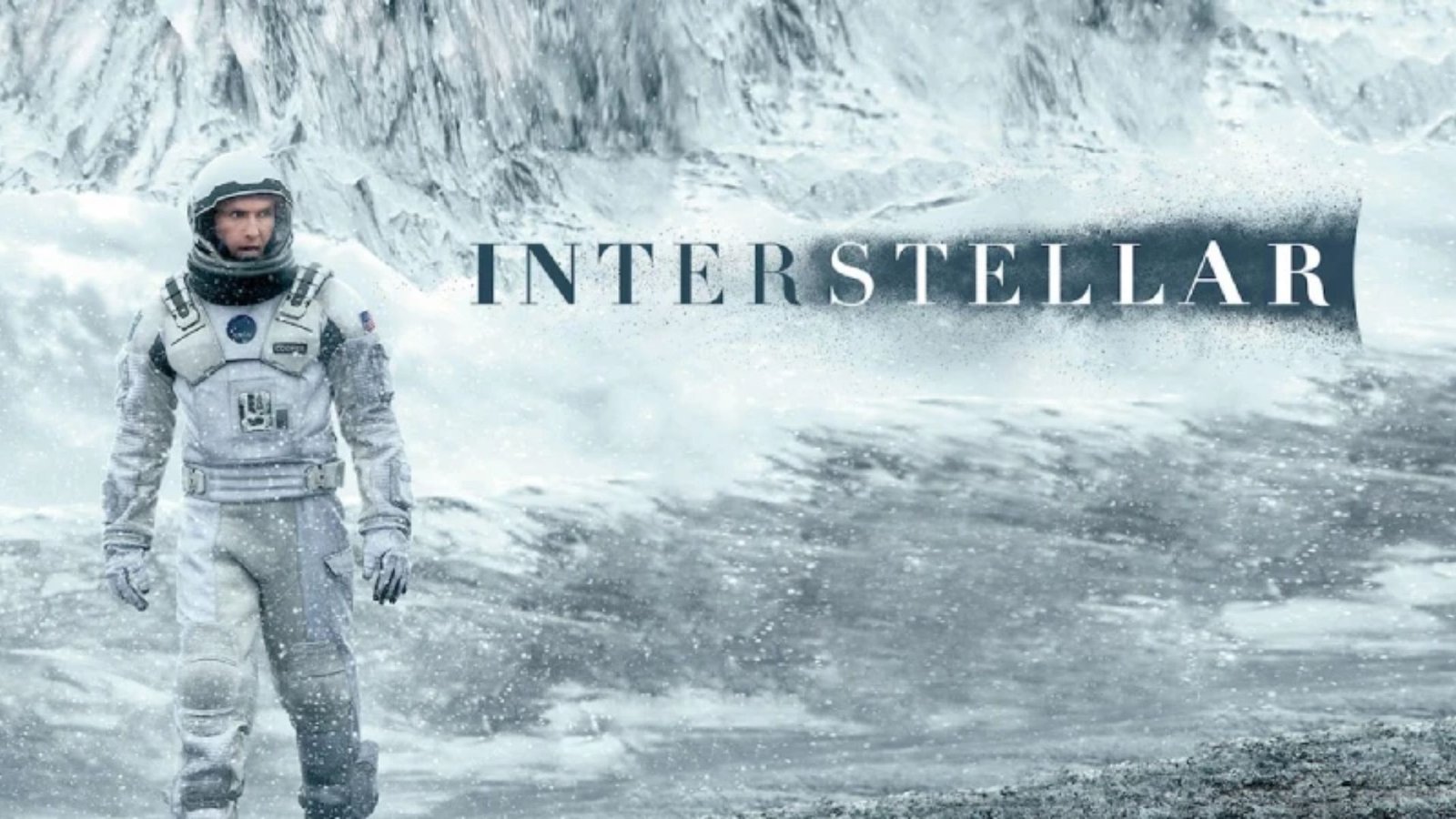
Interstellar is Christopher Nolan’s 2014 science-fiction epic about a dying Earth, a desperate space mission, and the emotional cost of time. The film follows former NASA pilot Joseph Cooper, played by Matthew McConaughey, who leaves his children to travel through a wormhole in search of a habitable world for humanity. Anne Hathaway, Jessica Chastain, Michael Caine, Mackenzie Foy, and Matt Damon also appear in major roles. The film combines cosmic ideas with a personal parent-child story.
What Is Interstellar About?
The story begins on a near-future Earth where crop failures, dust storms, and ecological decline have pushed society toward survival rather than exploration. Cooper is farming with his family when a gravitational pattern leads him and his daughter Murph to a hidden NASA facility. There, Professor Brand reveals a plan to send astronauts through a wormhole near Saturn to evaluate potentially habitable planets.
Cooper joins the Endurance mission alongside scientist Amelia Brand and other crew members. Their journey forces them to confront extreme time dilation, limited fuel, imperfect data, and the possibility that the original rescue plan may never work. The central conflict is simple: Cooper must choose between staying with his family and taking a chance on saving humanity.
| Element | What It Adds to the Film |
|---|---|
| Wormhole travel | Makes distant star systems reachable within the story |
| Time dilation | Turns relativity into an emotional problem |
| Gargantua black hole | Provides the film’s defining scientific imagery |
| Cooper–Murph relationship | Gives the mission a personal emotional core |
| Hans Zimmer’s score | Builds tension, awe, and scale |
The Science Behind the Film
One reason Interstellar remains distinctive is its serious engagement with physics. Physicist Kip Thorne served as a scientific consultant and executive producer, and the filmmakers worked with concepts from general relativity, black holes, gravitational lensing, and wormholes.
Gargantua was not designed as a purely decorative visual. Researchers and visual-effects artists developed a renderer that calculated how light could bend around a rapidly spinning black hole. A 2015 paper by Oliver James, Eugénie von Tunzelmann, Paul Franklin, and Thorne described the techniques used to create the image and said the goal was to show a black hole as it might appear to a nearby observer.
The film still takes dramatic liberties. Its treatment of higher-dimensional beings, communication through gravity, and survivability near extreme environments moves beyond established, testable science. The movie uses genuine physics as a framework, then becomes speculative where the story requires it.
💡 Pro Tip
If you are watching Interstellar mainly for the science, pay close attention to the scenes on Miller’s planet and around Gargantua. They make the central idea about relativity easier to grasp: time does not pass at the same rate for everyone when gravity and velocity differ dramatically.
Why Time Matters More Than Space
The film’s most powerful device is not the wormhole but time. On Miller’s planet, intense gravitational time dilation means a short visit costs the crew years relative to people farther away. The concept becomes a human consequence. Cooper can cross enormous distances, but he cannot recover the years he loses with his children.
That tension is why the movie works for audiences who are less interested in astrophysics. At its core, Interstellar is about separation, guilt, memory, and the hope that a relationship can survive impossible circumstances. Murph’s anger at her father is not a side plot; it is the emotional structure holding the story together.
Cast, Direction, and Visual Style
Christopher Nolan directed the film and co-wrote the screenplay with Jonathan Nolan. Matthew McConaughey plays Cooper, Anne Hathaway plays Amelia Brand, Jessica Chastain portrays adult Murph, and Michael Caine plays Professor Brand. The Academy records five Oscar nominations for the film, including Original Score, Production Design, Sound Editing, and Sound Mixing; it won the Academy Award for Visual Effects.
Nolan and cinematographer Hoyte van Hoytema used large-format film photography for much of the production. Spacecraft interiors, landscapes, miniatures, and digital effects are blended so the futuristic setting often feels physical rather than glossy. Hans Zimmer’s organ-driven score adds another distinctive layer, giving quiet moments unusual scale.
Why the Ending Is Still Debated
The final act moves from relatively grounded science into a speculative interpretation of gravity, time, and higher dimensions. Cooper enters Gargantua and reaches a constructed space often called the tesseract, where different moments in Murph’s childhood appear accessible at once. He realizes that the mysterious gravitational signals Murph observed were created by him.
Some viewers read this as a literal science-fiction mechanism built by advanced descendants of humanity. Others see it mainly as a thematic device that turns ideas about love, memory, and persistence into visual form. Both readings can coexist because the ending resolves the emotional story while leaving some mechanics open to interpretation.
📌 Key Takeaway
Interstellar succeeds because its science and family drama are not separate attractions. Relativity, gravity, distance, and time all become pressures on the same central relationship, giving the film an emotional logic that remains understandable even when the physics becomes complex.
Frequently Asked Questions
Is Interstellar scientifically accurate?
Parts of it are unusually well grounded for a mainstream science-fiction film. The depiction of gravitational lensing around Gargantua was developed with physicist Kip Thorne and informed by relativity calculations. Other elements, especially the tesseract and communication across time through gravity, are speculative storytelling rather than established scientific fact.
How long is the movie?
The widely released version runs about 2 hours and 45 minutes. That length gives the film room to develop its Earth-based family story, the Endurance mission, multiple planetary encounters, and the final black-hole sequence without compressing its major scientific and emotional ideas.
Why does time move differently on Miller’s planet?
Miller’s planet orbits extremely close to the massive, rapidly spinning black hole Gargantua. In the story, the intense gravitational field causes severe gravitational time dilation, so time passes much more slowly for people on the planet than for people farther away.
Did Interstellar win an Oscar?
Yes. The film received five nominations at the 87th Academy Awards and won for Visual Effects. Its other nominations were for Original Score, Production Design, Sound Editing, and Sound Mixing.
What is the main message of the film?
The film explores survival, sacrifice, scientific curiosity, and the bond between parents and children. It also asks how people make decisions when evidence is incomplete and the stakes are enormous. Its emotional argument is that human connection can motivate action across distances and timescales that otherwise feel incomprehensible.
Final Thoughts
More than a decade after its release, Interstellar still stands out because it treats scientific ideas as dramatic forces rather than background decoration. The black hole imagery, time-dilation sequences, production design, and Zimmer score create spectacle, but the lasting impact comes from Cooper and Murph. Their relationship gives the film a human scale, turning a story about the survival of the species into one about the cost of leaving home and the hope of finding a way back.

1 Comment
Pingback: Crime Movies: 12 Essential Films Every Fan Should See- QuantumRun