

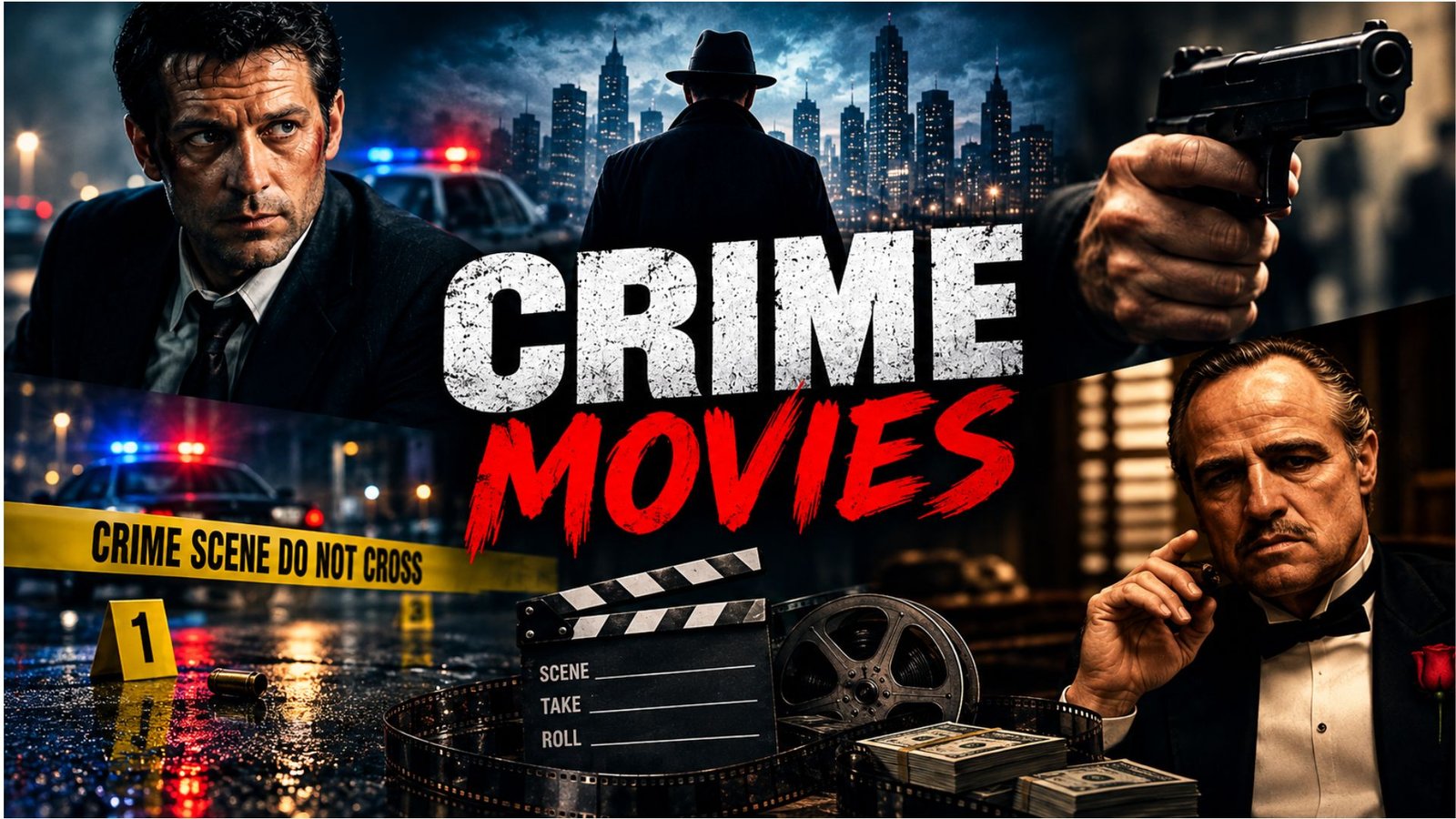
Crime movies remain one of cinema’s most flexible genres. They can be gangster epics, heist thrillers, noir mysteries, police dramas, or character studies about ambition, loyalty, corruption, guilt, and power.
For viewers in the USA and UK, strong starting points range from The Godfather and Heat to British classics such as The Long Good Friday and The Third Man.
What Makes Great Crime Movies Stand Out?
Strong crime films create tension from choices, not violence alone. A robbery may drive the plot, but the real drama often comes from mistrust, police pressure, family conflict, or a plan beginning to collapse.
American gangster stories often explore organized crime and power, while British crime cinema has a rich tradition of heists, noir, underworld dramas, and stories shaped by class and urban life. AFI defines the gangster film around organized crime or independent criminals in a twentieth-century setting, while BFI selections show how broadly the larger crime genre can stretch.
| Film | Year | Main Subgenre | Best For |
|---|---|---|---|
| The Godfather | 1972 | Gangster drama | Family and power |
| Chinatown | 1974 | Neo-noir mystery | Corruption and investigation |
| The Long Good Friday | 1980 | Gangster thriller | British underworld tension |
| Heat | 1995 | Heist thriller | Cops-versus-robbers intensity |
| L.A. Confidential | 1997 | Neo-noir | Police corruption |
| The Departed | 2006 | Crime thriller | Infiltration and betrayal |
12 Crime Movies Worth Watching
The Godfather (1972)
Francis Ford Coppola’s The Godfather is an essential starting point. Its story of the Corleone family combines organized crime with inheritance, family duty, business, and moral decline. AFI ranks it first among its American gangster films.
Goodfellas (1990)
Martin Scorsese’s Goodfellas offers a faster, more volatile view of mob life. It emphasizes seduction, paranoia, ego, and sudden brutality, making it especially accessible to viewers who want crime movies driven by character and momentum.
Heat (1995)
Michael Mann’s Heat centers on a professional thief and the detective pursuing him. It combines meticulous heist mechanics with loneliness, obsession, and the personal cost of living entirely for the job.
Chinatown (1974)
Roman Polanski’s Chinatown uses a private-eye mystery to uncover layers of corruption in Los Angeles. What begins as a domestic case develops into a larger story about money, influence, deception, and power.
💡 Pro Tip
If you are new to the genre, alternate between subgenres instead of watching only gangster films. Pair The Godfather with Chinatown, Heat, and The Long Good Friday. That mix gives you a clearer sense of how broad crime cinema really is.
The Long Good Friday (1980)
For British crime movies, The Long Good Friday remains a defining London gangster film. Bob Hoskins plays an ambitious criminal whose carefully planned future is threatened by attacks he cannot immediately explain. The BFI has highlighted the film within London crime cinema.
The Third Man (1949)
Carol Reed’s The Third Man blends noir atmosphere, mystery, black-market crime, and postwar unease in Vienna. Its moral ambiguity makes it an excellent choice for viewers interested in classic British crime cinema. The BFI includes it among essential British film noirs.
L.A. Confidential (1997)
Set in 1950s Los Angeles, L.A. Confidential follows police officers whose ambitions and methods differ sharply. A murder investigation gradually exposes corruption, celebrity culture, and institutional compromise.
The Departed (2006)
The Departed turns infiltration into a pressure cooker. One man works inside the police for organized crime, while another operates undercover within the criminal organization. The suspense comes from identity, exposure, and the fear that either side may discover the truth first.
No Country for Old Men (2007)
The Coen brothers’ No Country for Old Men begins with stolen drug money but becomes a pursuit story about chance, violence, and an aging lawman confronting a world he no longer understands.
Reservoir Dogs (1992)
Quentin Tarantino’s Reservoir Dogs largely skips the robbery itself and concentrates on the disastrous aftermath. Suspicion spreads among the surviving criminals as they try to identify an informant, proving that a crime film does not need a huge scale to create tension.
The Lavender Hill Mob (1951)
British crime comedy has its own tradition, and The Lavender Hill Mob is a standout example. An unassuming bank employee devises a gold robbery involving bullion disguised as souvenirs. The BFI identifies it as a key British heist film.
Strangers on a Train (1951)
Alfred Hitchcock’s Strangers on a Train turns a chance encounter into a murderous proposition between two strangers. The BFI highlights it as a classic “perfect crime” story in which planning and psychological pressure matter as much as the act itself.
How to Choose the Right Crime Film
The best choice depends on the tension you enjoy. For organized crime and family drama, start with The Godfather or Goodfellas. For investigation and corruption, choose Chinatown or L.A. Confidential. Heat delivers a serious heist story, while Reservoir Dogs focuses on betrayal after the job goes wrong.
Viewers interested in British crime movies should begin with The Long Good Friday, The Third Man, and The Lavender Hill Mob because together they show three different traditions: gangster drama, noir, and comic heist storytelling.
📌 Key Takeaway
The genre is much broader than mob stories. Its strongest films use illegal acts as a framework for exploring character, power, fear, class, loyalty, corruption, and consequence. A varied watchlist gives a better introduction than choosing only famous gangster titles.
Frequently Asked Questions
What are the best crime movies for beginners?
The Godfather, Heat, Chinatown, Goodfellas, and The Departed are strong starting points because each highlights a different strength of the genre. Together they cover organized crime, heists, investigation, undercover work, family conflict, and police pressure, giving new viewers a useful range without requiring deep knowledge of film history.
What is the difference between a crime film and a gangster film?
A gangster film is a narrower category focused mainly on organized crime, criminal gangs, or professional offenders. Crime cinema is broader and can include murder mysteries, heists, police corruption, noir, courtroom stories, prison narratives, con artists, and conspiracies. A gangster film is therefore usually a crime film, but not every crime film is a gangster story.
Which British crime films should I watch first?
Start with The Long Good Friday for a hard-edged London gangster story, The Third Man for classic noir atmosphere, and The Lavender Hill Mob for a lighter heist. Together they reveal the range of British crime cinema, from underworld power struggles to moral ambiguity and comic criminal planning.
Are crime movies always violent?
No. Some crime films use substantial violence, but others build suspense through planning, deception, investigation, surveillance, betrayal, or moral pressure. Heist films and noir mysteries can remain tense even when violence is limited. What matters most is the risk surrounding the crime and the consequences created by the characters’ decisions.
Final Verdict
A great crime film is rarely memorable because of the illegal act alone. It lasts because the characters want something badly enough to risk freedom, relationships, status, or life itself. The best crime movies turn those risks into stories about human behavior, which is why American and British classics remain compelling decades after release.

2 Comments
Pingback: Elon Musk SpaceX: Rockets, Starlink and Starship in 2026- QuantumRun
Pingback: Hurricane Katrina Documentary: Best Films to Watch Now- QuantumRun