

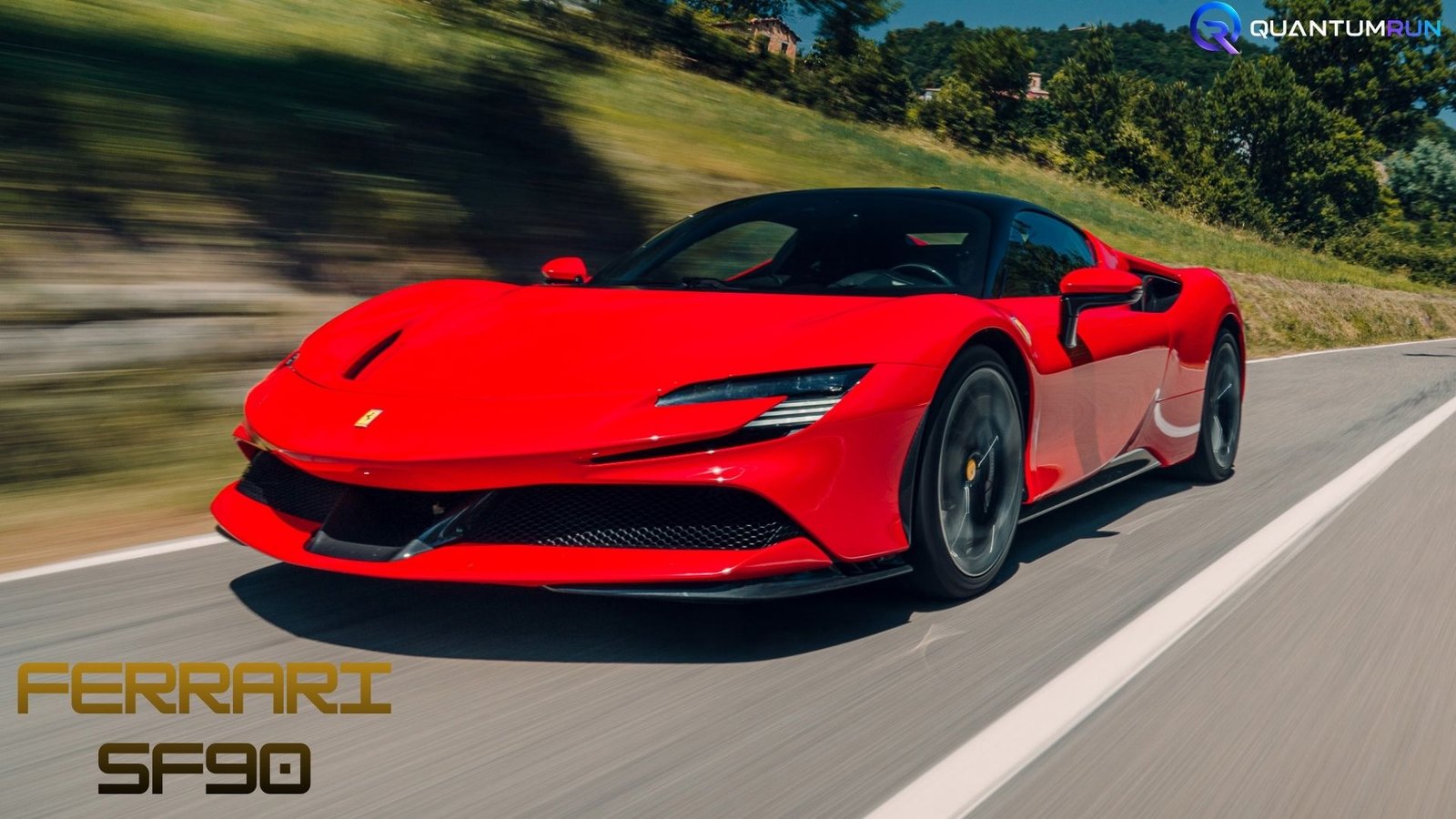
If you are shopping for a Ferrari SF90, the hardest part is not understanding how fast it is. The numbers are easy: a 1,000 cv hybrid powertrain, 0–100 km/h in 2.5 seconds, all-wheel drive, and a 340 km/h top speed. The harder question is which SF90 actually makes sense for you.
The Ferrari SF90 family includes the SF90 Stradale coupe, the open-top SF90 Spider, and the much more track-focused SF90 XX Stradale. They share the same basic hybrid philosophy, but they are very different cars once you consider comfort, weight, aerodynamics, collectability, and running costs.
That matters if you are looking at a Ferrari SF90 Spider, searching for a Ferrari SF90 for sale, or wondering whether the Ferrari SF90 XX Stradale is worth the enormous jump in exclusivity.
This guide breaks down what makes the SF90 special, what ownership is really like, what to inspect on a used example, and which version is the smartest choice for different buyers.
What Is the Ferrari SF90?
The SF90 Stradale was introduced in 2019 as Ferrari’s first series-production plug-in hybrid electric vehicle. Its powertrain combines a 3.99-liter twin-turbo V8 with three electric motors: two at the front and one mounted between the engine and transmission.
The result is 1,000 cv (735 kW) in total. Ferrari also gave the SF90 four-wheel drive, allowing the electric front axle to help put that enormous output onto the road.
The important thing is that the SF90 isn’t simply a V8 Ferrari with an electric motor added for efficiency. The hybrid system fundamentally changes how the car delivers performance.
Key Ferrari SF90 Stradale figures
- 3,990 cc twin-turbo V8
- 780 cv from the combustion engine
- 1,000 cv combined system output
- Three electric motors
- Plug-in hybrid powertrain
- 8-speed dual-clutch transmission
- All-wheel drive
- 0–100 km/h: 2.5 seconds
- 0–200 km/h: 6.7 seconds
- Top speed: 340 km/h
- Electric driving range: approximately 25 km
Ferrari’s official specifications for the Spider are broadly similar, including the 1,000 cv combined output and 2.5-second 0–100 km/h time.
Ferrari SF90 Stradale vs SF90 Spider
At first glance, choosing between the coupe and Spider seems straightforward: one has a fixed roof and the other doesn’t.
In reality, there is more to it.

6
The SF90 Spider uses Ferrari’s retractable hard-top system. The roof can open or close in about 14 seconds and can be operated at speeds of up to 45 km/h.
For someone who regularly drives in warm weather, the Spider can make more emotional sense. You get the same outrageous acceleration while being able to experience the V8 and exhaust character more directly.
The Stradale, however, has a slightly more focused identity. If your priority is maximum involvement on fast roads or occasional track work, the fixed-roof configuration is the more natural starting point.
Which one should you choose?
Choose the Stradale if:
- You prioritize driving precision.
- You want a more traditional fixed-roof supercar experience.
- Track driving matters to you.
- You prefer the cleaner coupe profile.
Choose the Spider if:
- Open-air driving is a major part of the experience.
- You live somewhere with favorable weather.
- You want the SF90’s performance without giving up the convertible experience.
- You value theater and occasion as much as outright performance.
One interesting ownership point is that the Spider isn’t merely a cosmetic alternative. Ferrari had to engineer the retractable roof into an already complex hybrid supercar, so inspecting the roof mechanism and its operation should be part of any used-car inspection.
What Makes the SF90 So Fast?
The answer isn’t just horsepower.
The SF90’s biggest advantage is how its different systems work together.
The V8 produces 780 cv, while the electric motors contribute additional power. The two front electric motors can independently control the front wheels, while another electric motor works at the rear.
That means the car can distribute propulsion extremely quickly.
From the driver’s seat, this can make the SF90 feel almost deceptively easy to drive quickly. Instead of waiting for a conventional drivetrain to build momentum, the electric motors provide immediate response while the turbocharged V8 takes over the higher-speed performance.
This is one of the SF90’s most important characteristics:
its speed feels accessible rather than dramatic at first.
That can be both its greatest strength and its biggest surprise.
Ferrari SF90 Driving Experience
A common mistake is to judge the SF90 purely by its acceleration figure.
Drive it at normal speeds and the car can feel surprisingly civilized. The hybrid system allows quieter electric operation, while the automatic transmission removes much of the effort associated with driving a high-performance manual or aggressive dual-clutch car.
Then you switch into a more aggressive mode and the character changes.
The SF90 uses Ferrari’s electronic control systems to coordinate the engine, electric motors, traction, braking and torque delivery. Ferrari designed the system so the driver doesn’t have to manually manage all of that complexity.

The four powertrain personalities
The car’s hybrid system offers different operating philosophies, including:
- eDrive — prioritizes electric driving.
- Hybrid — balances efficiency and performance.
- Performance — keeps the powertrain ready for more aggressive driving.
- Qualify — releases the maximum performance potential.
This makes the SF90 unusually broad in its abilities. It can behave like a quiet urban car for a short journey and then transform into a seriously capable performance machine.
Ferrari SF90 for Sale: What Should You Check?
If you’re searching for a Ferrari SF90 for sale, don’t make the mistake of comparing cars based only on mileage and asking price.
A lower-mileage example isn’t automatically the better purchase.
Ferrari’s option list can dramatically change the value and character of an SF90. Carbon-fiber components, wheel choices, seats, interior specifications, driver-focused equipment and track-oriented packages can make two visually similar cars very different purchases.
Before buying a used SF90, check:
- Complete Ferrari service history
- Hybrid-system condition
- Battery health and charging behavior
- Transmission operation
- Brake condition
- Tire age and wear
- Accident and paint history
- Carbon-fiber components
- Suspension operation
- Cooling system
- Retractable roof on Spider models
- Original specification and factory options
- Warranty or approved-used coverage where applicable
One uncommon but important insight: don’t judge a hybrid Ferrari by engine mileage alone. A low-mileage car that has spent long periods sitting unused isn’t automatically healthier than a regularly serviced example that has been driven properly.
Another practical point is to inspect the tires closely. An SF90 can cover surprisingly few miles while still suffering from age-related tire degradation, especially if it has been stored for extended periods.
How Much Does a Ferrari SF90 Cost?
Prices vary dramatically by market, specification, mileage and condition.
Current used-market tracking in August 2026 shows a substantial difference between Stradale and Spider examples. One independent market tracker reports a median asking price around $479,000 for Stradale listings and approximately $620,000 for Spider listings, although individual cars vary considerably.
Completed-sale data can tell a different story from asking prices. Recent verified SF90 Stradale auction sales have ranged widely, demonstrating why buyers should not treat an advertised price as the car’s actual market value.
In Pakistan, local automotive listings currently show used SF90 pricing around PKR 115 million, but import status, taxes, registration, mileage, specification and condition can materially change the final cost.
So, when searching for an SF90 for sale, think in terms of total ownership cost, not simply the advertised purchase price.
Ferrari SF90 XX Stradale: How Different Is It?
The SF90 XX Stradale takes the standard SF90 concept much further.
Ferrari increased total output to 1,030 cv, with the V8 producing 797 cv and the electric motors contributing up to 233 cv. Ferrari also reduced weight and substantially reworked the aerodynamics and control systems.
The result is not simply a faster SF90.
It is much more track-oriented.
The XX Stradale produces substantially more aerodynamic performance, uses a fixed rear wing, and receives a more aggressive chassis and electronic calibration. Ferrari reports a 0–100 km/h time of 2.3 seconds and a 0–200 km/h time of 6.5 seconds.
It also achieved a 1:17.309 lap at Fiorano, setting a record for a road-homologated car at the time. Ferrari says the car was equipped with carbon-fiber wheels and Michelin Cup 2R tires for that run.
SF90 vs SF90 XX Stradale
| Feature | SF90 Stradale | SF90 XX Stradale |
|---|---|---|
| Power | 1,000 cv | 1,030 cv |
| 0–100 km/h | 2.5 sec | 2.3 sec |
| Character | Road-focused | Track-focused |
| Aero | High performance | Much more aggressive |
| Comfort | Better suited to road use | More performance-biased |
| Availability | Regular production model | Limited-series model |
| Collectability | Strong | Exceptional |
The interesting part is that the XX’s extra 30 cv isn’t the whole story.
Its real advantage comes from aerodynamics, weight reduction, chassis tuning and software calibration. That’s why comparing the two cars only by horsepower misses what Ferrari changed.
Is the Ferrari SF90 Practical Enough for Daily Driving?
Surprisingly, yes — with qualifications.
The SF90 is still a two-seat supercar with limited luggage space and expensive consumables. Poor roads, steep ramps, aggressive speed bumps and crowded parking areas can quickly remind you what you’re driving.
But the hybrid system gives it a usability advantage over some older exotic cars.
For short trips, electric operation can make the car considerably calmer. The automatic transmission is easy to live with, and the car’s electronic systems do much of the hard work.
The bigger concern isn’t whether you can daily-drive it.
It’s whether you are comfortable with the financial consequences of doing so.
Regular driving means greater exposure to tire wear, brakes, stone chips, suspension damage and other expensive consumables. A garage queen may preserve mileage, but a carefully maintained driver can sometimes make a more sensible used purchase.
Common Ferrari SF90 Buying Mistakes
1. Buying the cheapest example
A low price can be attractive, but on an exotic hybrid, a cheap car can become expensive very quickly.
2. Ignoring the specification
Two SF90s with similar mileage can have very different desirability because of factory options.
3. Skipping an independent inspection
Even if the seller has an excellent reputation, an independent inspection is worthwhile before committing serious money.
4. Focusing only on horsepower
The SF90’s engineering is about integration. Battery condition, electronics, cooling, brakes, tires and software are just as important to the ownership experience.
5. Assuming low mileage means perfect condition
Storage history matters. Ask how frequently the car was driven, serviced and maintained rather than looking only at the odometer.
Who Should Buy a Ferrari SF90?
The SF90 makes the most sense for someone who wants a modern Ferrari that combines traditional supercar drama with advanced hybrid technology.
It is particularly compelling if you want:
- Extreme straight-line performance
- All-weather traction
- Hybrid flexibility
- A usable automatic transmission
- Supercar exclusivity
- A bridge between road-car comfort and track-level performance
The Spider is the better emotional choice for open-air driving, while the XX Stradale is aimed at buyers who care much more about circuit performance and limited-series exclusivity.
If your priority is simply owning the most exciting Ferrari possible, however, the answer may not be the one with the biggest specification sheet. The right SF90 is the car whose condition, history and configuration match how you actually intend to use it.
Frequently Asked Questions
Is the Ferrari SF90 faster than most supercars?
The SF90 remains exceptionally quick, with a 0–100 km/h time of 2.5 seconds in standard form and 2.3 seconds for the XX Stradale. Its combination of electric torque, all-wheel drive and a twin-turbo V8 makes its acceleration especially repeatable. The XX version goes further with additional power and significantly more aerodynamic development.
What is the Ferrari SF90 Spider?
The SF90 Spider is the open-top version of the SF90 hybrid supercar. It uses a retractable hard top that can open or close in approximately 14 seconds and can operate at speeds up to 45 km/h. Performance remains extremely close to the Stradale, including 1,000 cv of combined output and a 2.5-second 0–100 km/h time.
How much does a Ferrari SF90 cost used?
Used SF90 prices vary substantially according to model year, mileage, specification, location and condition. Current market data shows Stradale examples generally positioned below Spider models, while exceptional specifications can command substantially higher prices. Buyers should compare completed sales and vehicle histories rather than relying on one advertised listing.
Is the Ferrari SF90 XX Stradale street legal?
Yes. The SF90 XX Stradale is a road-homologated, limited-series Ferrari, despite its much stronger track focus. Ferrari developed it from the SF90 platform and equipped it with 1,030 cv and substantially more aggressive aerodynamic hardware.
Is the SF90 a good daily driver?
It can be, especially compared with many extreme supercars. Its hybrid system, automatic transmission and multiple driving modes make normal driving relatively manageable. However, running costs, ground clearance, tire wear, limited seating and expensive repairs mean it isn’t a conventional practical daily car.
Final Verdict
The Ferrari SF90 is important because it shows what happens when Ferrari stops treating electrification as an efficiency exercise and instead uses it to improve performance.
The standard SF90 Stradale delivers astonishing acceleration while remaining surprisingly usable. The SF90 Spider adds open-air drama without sacrificing the core performance formula. The SF90 XX Stradale takes the same architecture toward the track, adding power, downforce, weight savings and much more aggressive dynamics.
If you’re considering a Ferrari SF90 for sale, the smartest approach is to buy the car, not just the badge or headline horsepower. Prioritize documented maintenance, battery and hybrid-system health, factory specification, tire and brake condition, and a thorough inspection.
For most buyers, the Stradale or Spider will provide the best balance of extraordinary performance and real-world usability. The XX Stradale is something different: a limited-production statement for someone who wants the SF90 concept pushed much closer to a race car.
