

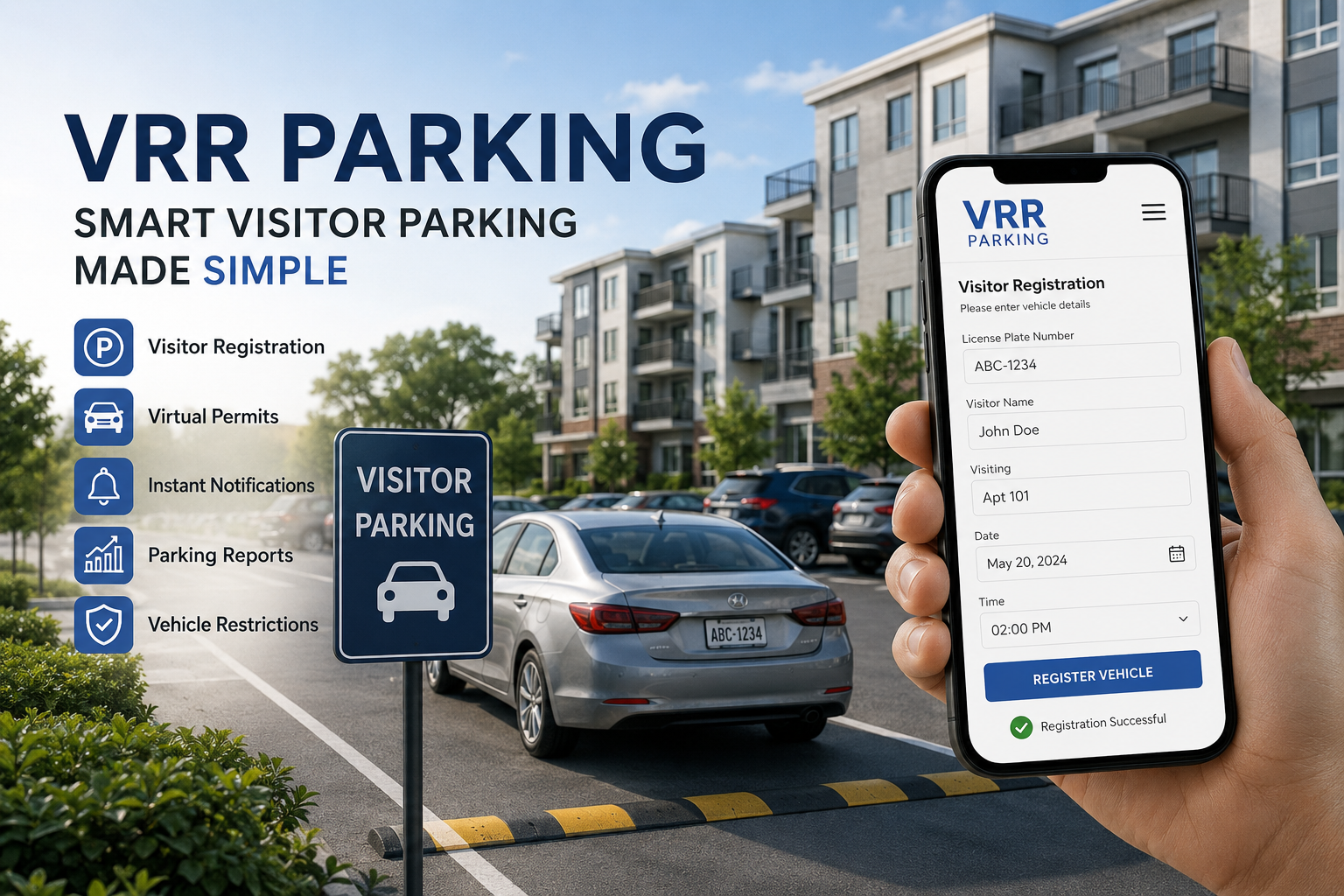
VRR parking is a visitor and resident parking management platform designed to help residential properties control who can park on private property. Instead of relying entirely on paper permits, handwritten logs, or manually updated lists, the system allows properties to register visitors, issue virtual permits, monitor parking activity, and maintain vehicle records digitally.
The platform is aimed primarily at apartment communities, residential developments, and property managers dealing with limited visitor spaces or recurring parking problems. According to the company’s website, its system supports visitor registration, resident profiles, virtual permits, notifications, reporting, and vehicle restrictions.
For residents and guests, understanding how the system works can make parking less confusing. For property managers, it can provide a more organized way to enforce parking policies without depending on physical permits alone.
What Is VRR Parking?
VRR Parking is a parking management software platform focused on visitor and resident registration. Its central purpose is to give property managers a digital method for controlling parking access and keeping track of vehicles using a private parking area.
A property can establish its own visitor parking process, allowing residents to register guests or, depending on the property’s setup, allowing visitors to register themselves. The platform says its system is used by more than 500 properties and that more than one million visitors book parking tickets annually.
The exact rules are not universal. A property manager can decide how visitor parking operates, including registration requirements, time limits, permits, and restrictions.
That distinction matters. VRR parking is not a universal public parking authority or a replacement for local parking laws. It is a private parking-management system whose rules depend on the property using it.
How VRR Parking Works for Visitors
The process generally starts when a visitor needs to park at a participating property. Depending on the property’s configuration, the visitor may be asked to register vehicle information directly, or the resident they are visiting may register the vehicle.
After registration, the system can generate a digital parking permit or ticket containing relevant vehicle and parking information. This creates a record that property managers can use to determine whether a vehicle has been properly authorized.
For visitors, the most important steps are straightforward:
- Check the property’s parking instructions before leaving your vehicle.
- Register the vehicle using the designated process.
- Enter the requested vehicle and visitor information accurately.
- Confirm the permitted parking period.
- Keep any digital confirmation or permit available if required.
- Follow posted restrictions even after registration.
A registration does not automatically mean that every parking space is available. Visitors still need to follow the property’s designated areas, time limits, and other posted requirements.
VRR Parking for Residents and Property Managers
Residents can benefit from virtual permits because there is less dependence on physical tags or paper passes. The company describes its resident registration system as a way to reduce the administrative work involved in issuing and updating resident profiles.
Property managers have a broader set of tools. The platform advertises visitor history, revenue reporting, automated notifications, blocked vehicles, time restrictions, and cloud-based access to resident information.
| Feature | What it can help with |
|---|---|
| Visitor registration | Records authorized guest vehicles |
| Virtual permits | Reduces dependence on physical parking passes |
| Resident profiles | Keeps resident vehicle information organized |
| Notifications | Sends parking-related updates |
| Reports | Tracks visitor activity and related information |
| Vehicle restrictions | Prevents selected vehicles from registering |
| Time limits | Helps control how long visitors can remain parked |
| Cloud access | Allows authorized management staff to access records remotely |
The practical value depends on how consistently the property uses the platform and communicates its parking policy to residents.
What Information May Be Required?
The information requested can vary by property, but vehicle registration systems commonly need enough information to identify the vehicle and associate it with an authorized visitor or resident.
This can include a vehicle registration or license plate number, visitor details, and the expected parking period. Residents may also have profiles connected to their address or unit.
Accuracy is especially important. Entering the wrong plate number can cause problems because parking enforcement may rely on the registered vehicle information rather than recognizing the driver personally.
Before submitting information, check the property’s instructions and make sure you are using the official registration method provided by the property.
💡 Pro Tip: Take a screenshot of your completed visitor registration or confirmation number before leaving the parking area. If there is later a question about whether the vehicle was registered, having the original confirmation can make it easier to verify what was submitted.
Is VRR Parking Legitimate?
VRR Parking presents itself as a commercial parking-management service, and its official website describes specific software features and services for residential parking management.
However, consumers should distinguish between the platform itself and individual parking signs, QR codes, or instructions appearing at a property.
The Better Business Bureau’s Scam Tracker contains a 2025 report from a person in Texas alleging that VRR-related parking signs were placed at an apartment community without management’s authorization. The report is an allegation submitted by a user, not proof that the platform or every VRR parking operation is fraudulent.
If a QR code or registration request appears unexpectedly, verify it with the apartment office, landlord, property manager, or another trusted property contact before submitting personal or vehicle information.
This is particularly useful when the instructions conflict with existing parking rules.
What Happens If You Ignore the Parking Rules?
Consequences depend on the property’s agreement with its parking operator, local regulations, and the terms displayed at the property.
A private parking system may be used alongside towing arrangements or other enforcement procedures. The exact consequences therefore cannot be assumed from the software alone.
In the UK, for example, private parking rules and charges operate within a different legal framework from public highway restrictions. Government guidance defines private parking charges in relation to controlled private land and contractual parking conditions.
In the US, parking enforcement also varies significantly by state, municipality, property, and private agreement.
If you receive a parking notice, review the notice itself and the property’s posted terms rather than assuming that every parking dispute follows the same process.
VRR Parking vs. Traditional Visitor Permits
Traditional visitor parking often relies on paper passes, stickers, physical hangtags, or manually maintained lists. These approaches can work for small communities but become harder to manage when visitor traffic increases.
A digital system can make registration and recordkeeping more centralized. Virtual permits can also reduce the need to distribute replacement physical passes.
The trade-off is that residents and visitors must correctly use the digital registration process. If the system is unfamiliar, poor instructions or incorrect vehicle information can create unnecessary disputes.
For that reason, technology alone does not solve parking problems. Clear property rules and communication remain essential.
📌 Key Takeaway: VRR parking is best understood as a private parking-management platform rather than a general public parking service. If you are visiting a participating property, follow that property’s specific instructions, register the correct vehicle information, and verify unexpected parking requests with management.
Frequently Asked Questions
How does VRR Parking work?
VRR Parking provides digital tools for visitor and resident parking management. A participating property can use the platform to register visitors, create virtual permits, manage vehicle information, send notifications, and review parking records. The exact registration process and restrictions depend on the individual property’s parking policy.
Do visitors need to register their vehicles?
If a property requires visitor registration, guests generally need to complete the property’s designated process before or when they park. Some properties allow residents to register visitors, while others may allow visitors to register themselves. Always follow the instructions displayed at the specific property.
Is VRR Parking a public parking authority?
No. VRR Parking is a private parking-management platform. It provides software and related services to properties that use its system. Public parking laws, municipal rules, and local traffic regulations remain separate from the software.
What should I do if a VRR parking QR code looks suspicious?
Do not enter personal or vehicle information immediately. Contact the apartment office, landlord, property manager, or another verified property representative and ask whether the QR code and parking instructions are authorized. This is especially important if the signs appear suddenly or contradict established parking rules.
Can property managers use VRR Parking for resident permits?
Yes. The platform advertises resident registration and virtual permits as part of its parking-management services. It also provides tools for visitor registration, reporting, notifications, and vehicle restrictions. The features available to residents depend on how their property configures the system.
Conclusion
VRR parking provides a digital approach to a problem that many residential properties face: controlling visitor vehicles while keeping parking information organized. Its tools can support virtual permits, visitor registration, resident records, notifications, and reporting.
For residents and guests, the safest approach is simple: follow the property’s instructions, enter vehicle information carefully, respect posted restrictions, and verify unfamiliar registration requests before submitting information. For property managers, the platform can provide a centralized alternative to purely manual visitor parking processes.

1 Comment
Pingback: Ferrari SF90: The Supercar That Changed Ferrari- QuantumRun